Tuesday, 7 May 2013

Ebrahim Al-Arrayedh: The Life of a Bahraini Poet

Ebrahim Al-Arrayedh (in Arabic: إبراهيم العريّض‎, born 8 March 1908 – died May 2002) was a Bahraini writer and poet, and is generally considered to be one of Bahrain's greatest poets and one of the leaders of the Bahraini literary movement in the 20th century. In this article, we'll try to see why he is regarded as such.

Biography:

Arrayedh was born in Bombay, India to his Bahraini parents on 8 March 1908. In 1922, he visited Bahrain for the first time at age 14, where he started his education at the country's first school, the Hidaya al-Khalifa school though he did not permanently reside in the island. He returned to Bombay in 1926 and enrolled at a local school where he earned his high school diploma. It was at this school that Al-Arrayedh studied Farsi and the English language, alongside Urdu, and had expressed a deep interest in Urdu literature. He later studied Urdu literature at the Aligarh Muslim University.

In 1927, Al-Arrayedh returned to Bahrain and was appointed as an English teacher in the Hidaya al-Khalifa school, a position he held for four years. He later became the deputy director of the Jafari school though he was forced to quit his job over disputes with the British colonial authorities. After this, he served as a treasurer in the State Customs Service. In 1937, he moved on to become the head of a translation department in a Bahraini company, which did not last as a result of the outbreak of World War II. In 1943, he traveled to Delhi and worked at a radio station. He later returned to Bahrain where he worked for the Bahrain Petroleum Company until 1967, when he retired.

Poetry and honours:

Since the age of 18, Al-Arrayedh began writing poetry, with his first set of poems being published in Baghdad in 1931. Since he was a multi-linguist, he translated the works of poets between Persian, Hindi, Urdu, English, and Arabic. His poems were popular in Iraq, Syria and Egypt; such that the American University of Beirut asked him to deliver lectures on Arab literature, which he had agreed to. Ebrahim published another collection of poems, The Dolls, in 1946. This was followed by another three compilations, two poetic dramas, four critical studies of Arabic poetry, one poetry collection in Urdu and another in English. He translated Al Khayami's Rubayat from Persian into Arabic in 1966. Throughout his life, Al-Arrayedh lectured widely and travelled extensively to participate in conferences and debates in the field of poetry

He was awarded the Shaikh Isa bin Salman Al Khalifa Order - First Class, by the Bahraini government.  He was also a noted reformer setting up a school, and was appointed head of the Constitutional Council by the emir Sheikh Isa Bin Salman Al-Khalifa. In short, Ebrahim was responsible for developing Bahrain's constitution in the early 1970s prior to independence from the United Kingdom. He served as Bahrain's ambassador-at-large (which is a diplomat of the highest rank or a minister who is accredited to represent his country internationally) in 1974 and later as ambassador extraordinary plenipotentiary at the Ministry of Foreign Affair, a position he held until his death in 2002.
Ebrahim al-Arrayedh in his later years

Death and legacy:

Ebrahim died in May 2002 at the age of 94, after suffering breathing problems. He was buried in the Manama graveyard, next to his late daughter Layla Al-Arrayedh who died the preceding year.

Following his death, the King Hamad bin Isa Al-Khalifa, named one of the Kingdom’s most geographically important roads after him — opposite the Bahrain Financial Harbour. In 2006, his old house, in Gudaibiya, in the capital city of Manama, was turned into a cultural centre, the Ebrahim Al-Arrayedh Poetry House, open to tourists and as a meeting place for poets.

In 2008, the United Nations Educational, Scientific and Cultural Organisation held an exhibition in Al-Arrayedh's honour in its headquarters in Paris, France.

Notable works:
(In Arabic, couldn't find a decent translation.) 
(A larger collection of his poems can be found here)

Monday, 25 March 2013

The World's First Airstrike

Gavotti aboard Farman biplane, Rome 1910
In April 2011, Italy had announced it would join NATO's air attacks in Libya, then in the middle of its civil war. It would later prove a classical case of history repeating itself.

A century ago, in September 1911, the Italian armed forces invaded Ottoman-held Libya with the intent of establishing an Italian colonial empire, something that Italy lacked whilst its French and German neighbors prided upon. This led to the Italo-Turkish war which dragged on until October 1912, with the Italians winning control of Libya, having subdued Turkish and Libyan resistance.

Insignificant as this war may seem to us, the Italian Turkish war saw numerous technological advancements deployed in battle. One of them, most notable, being aeroplanes.

This brings us to the story of a young Italian aviator, lieutenant Giulio Gavotti, who was deployed to Libya to oversee the transport of aeroplanes. But within a few months, Gavotti had done what no man had done before in warfare. Gavotti was the world's first air-bomber, only eight years after the monumental flight of the Wright Brothers at Kitty Hawk, North Carolina.

On the first of November 1911, Gavotti boarded his Etrich Taube aeroplane and took with him four grenades, weighing a kilo and a half each. Gavotti took off and headed for Ain Zara. It is now a town just east of Tripoli, but at the time he described it as a small oasis. There he would have expected to find Arab fighters and Turkish troops that were allied in the fight against the Italian invasion.
The type of plane used in the airstrike, the Etrich Taube

Flying at an altitude of 600 feet, Gavotti screwed in the detonators and tossed each grenade over the side of the plane. Whilst unknown, Gavotti's mission is believed to have been a failure, having failed to cause any reported casualties.

Back home in Italy, the Italian press was ecstatic, with many newspapers reporting the exploit in high regards, to strengthen support for the war at home. Gavotti had shown it was possible to use aeroplanes to aid warfare (a contrast to the Wright Brothers' opinion that aeroplanes were "tools of peace".) and may have inadvertedly paved the way for the horrors of Dresden, Hiroshima and countless others to occur.
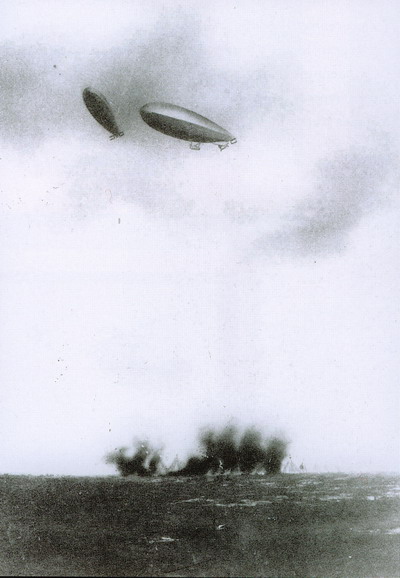
Zepplin bombing, during the Italian Turkish War, 1911.
Trivia:
Future dictator of Italy, Benito Mussolini (then a left-wing socialist), was vehemently opposed to the Italian-Turkish War.

Friday, 8 March 2013

The Surrender of Japan: A Brief Overview

Japanese foreign affairs minister Mamoru Shigemitsu signs the Japanese Instrument of Surrender on board USS Missouri as General Richard K. Sutherland watches, September 2, 1945
The surrender of the Empire of Japan on September 2, 1945, brought the hostilities of World War II to a close. By the end of July 1945, the Imperial Japanese Navy was incapable of conducting operations and an Allied invasion of Japan was imminent. While publicly stating their intent to fight on to the bitter end, the Empire of Japan's leaders, (the Supreme Council for the Direction of the War, also known as the "Big Six"), were privately making entreaties to the neutral Soviet Union to mediate peace on terms favorable to the Japanese. The Soviets, meanwhile, were preparing to attack the Japanese, in fulfillment of their promises to the United States and the United Kingdom made at the Tehran and Yalta Conferences.

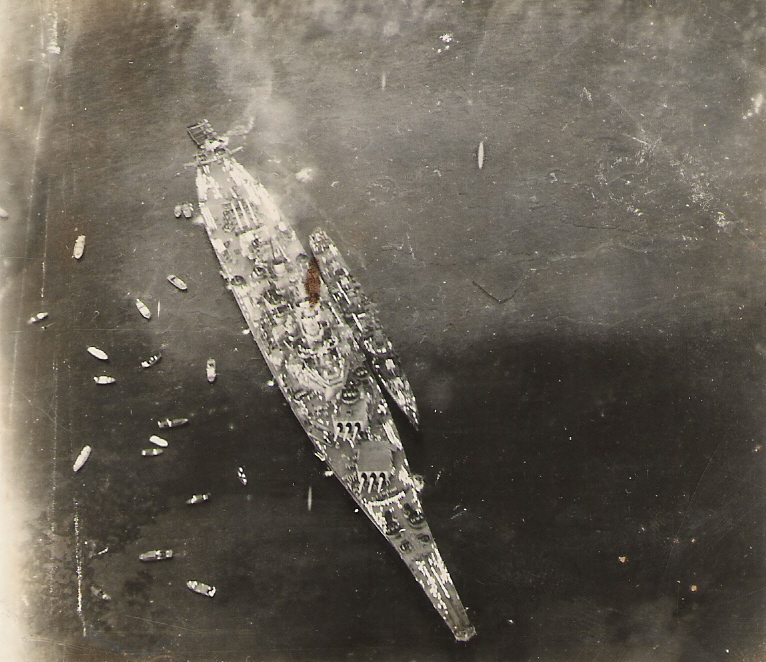
The USS Missouri on the day of the signing, 2 September 1945
 On August 6, 1945, the United States dropped an atomic bomb on the city of Hiroshima. Late in the evening of August 8, 1945, in accordance with the Yalta agreements, but in violation of the Soviet–Japanese Neutrality Pact, the Soviet Union declared war on the Empire of Japan, and soon after midnight on August 9, 1945, the Soviet Union invaded the Imperial Japanese puppet state of Manchukuo. Later that day, the United States dropped another atomic bomb, this time on the city of Nagasaki. The combined shock of these events caused Emperor Hirohito to intervene and order the Big Six to accept the terms for ending the war that the Allies had set down in the Potsdam Declaration. After several more days of behind-the-scenes negotiations and a failed coup d'état, Emperor Hirohito gave a recorded radio address to the Empire on August 15. In the radio address, called the Gyokuon-hōsō ("Jewel Voice Broadcast"), he announced the surrender of the Empire of Japan to the Allies.

General of the Army Douglas MacArthur signing the Instrument of Surrender on behalf of the Allied Powers
On August 28, the occupation of Japan by the Supreme Commander for the Allied Powers began. The surrender ceremony was held on September 2, aboard the United States Navy battleship USS Missouri (BB-63), at which officials from the Japanese government signed the Japanese Instrument of Surrender, thereby ending the hostilities in World War II. Allied civilians and military personnel alike celebrated V-J Day, the end of the war; however, some isolated soldiers and personnel from Imperial Japan's far-flung forces throughout Asia and the Pacific islands refused to surrender for months and years afterwards, some even as far as into the 1970s. Since the surrender of the Empire of Japan, historians have continually debated the ethics of using the atomic bombs on Hiroshima and Nagasaki.
The Japanese Instrument of Surrender (click for larger image)

The state of war between Japan and the Allies formally ended when the Treaty of San Francisco came into force on April 28, 1952. Four more years passed before Japan and the Soviet Union signed the Soviet–Japanese Joint Declaration of 1956, which formally brought an end to their state of war.

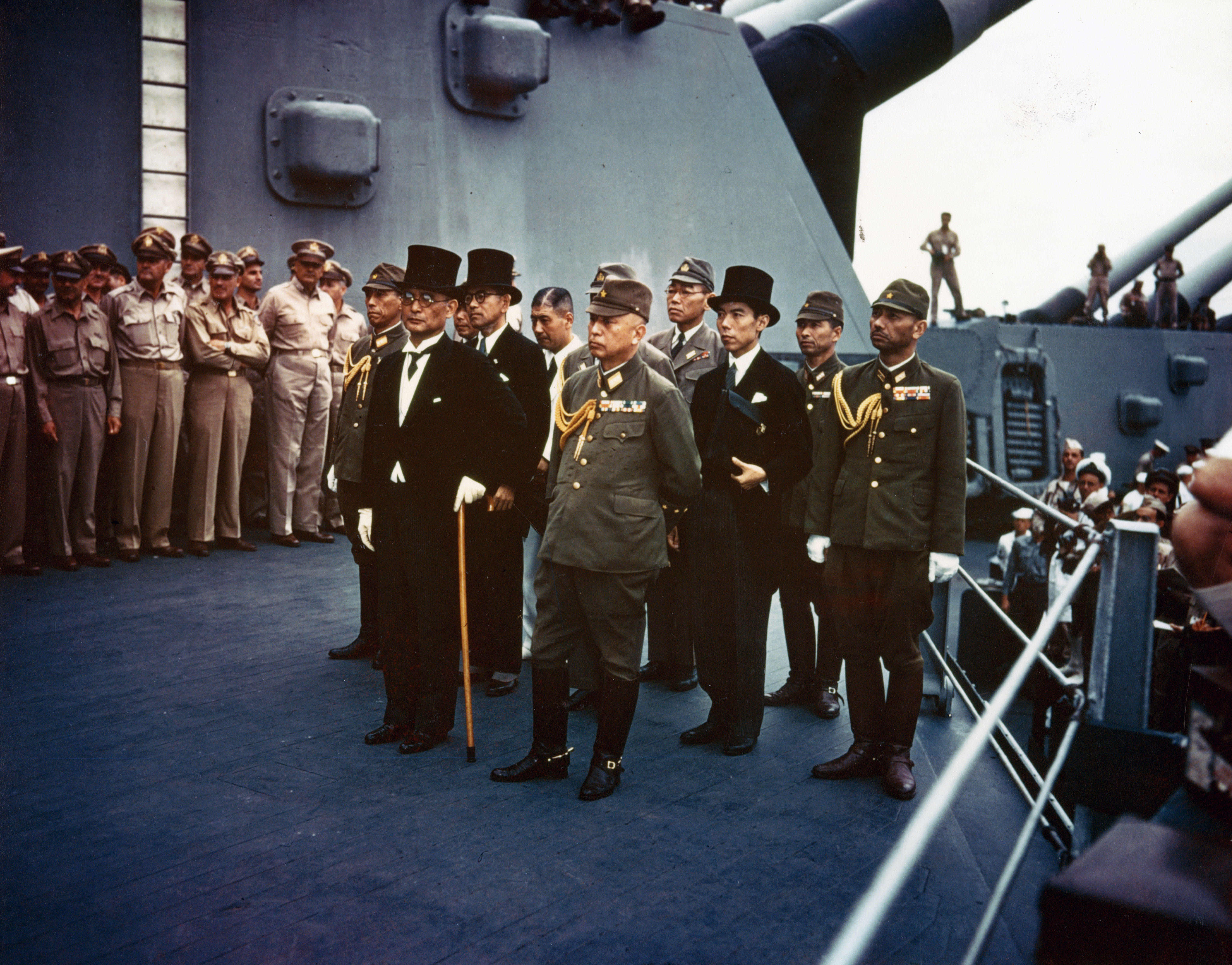
 Representatives of Japan stand aboard USS Missouri prior to signing of the Instrument of Surrender.

Saturday, 23 February 2013

History in Focus: Taiwan in the early 20th Century

Taiwan is an island state situated in East Asia and for the much of the early half of the 20th century, the island was controlled by Japan. Following the end of World War II, the island eventually came into the control of China (though officially, the details are murky, with Japan still exercising sovereignty over the island until 1952. See here). As a result of the Communist takeover of mainland China, the previous government relocated to Taipei in Taiwan and continue to stay there since.

During the latter half of the 20th century, Taiwan has experienced rapid economic growth and industrialization and is now an advanced industrial economy.

 In the 1980s and early 1990s, Taiwan evolved into a multi-party democracy with universal suffrage. Taiwan is one of the Four Asian Tigers and a member of the WTO and APEC. The 19th-largest economy in the world,its advanced technology industry plays a key role in the global economy.

 Taiwan is ranked highly in terms of freedom of the press, health care, public education, economic freedom, and human development.

Here are some photos from TaiPics.com, which is an archive of over 7000 historical Taiwan pictures collected and organized by taipeimarc, an American expat in Taiwan. All images are believed to be in the public domain. I recommend you visit the website!

Overview of Taipei, Taiwan's capital, in the early 20th century
School session in Japanese-held Taiwan, prior to 1945
The Governor General's house and East Gate , circa 1920s.
School gathering
Farmers working
1945 bombing of Taipei
Taipai in the early 20th century
Taiwanese farmers on the field. Date unknown
Girls' school in Taiwan
Aborigines of Taiwan (historically called Formosa). Date unknown
Missionary school, date unknown.
Rice planting. Workers often worked till sunset. Date unknown
Opium den in Taiwan
Sugar manufacturing factory and plantation. The site is now a museum.
Sugarcane farming. Date unknown
Sugar bags from the 1940s.
Sun Moon Lake.
Aborigines canoeing in the Sun Moon Lake.
Unknown building in Taipai

Thursday, 14 February 2013

Remembering an Artist: Jean-Paul Laurens

Jean-Paul Lauren' self-portrait in 1876
Jean-Paul Laurens (28 March 1838 – 23 March 1921), was a French painter and sculptor, and one of the last major exponents of the French Academic style.

Born in Fourquevaux, he was a pupil of Léon Cogniet and Alexandre Bida. Strongly anti-clerical and republican, his work was often on historical and religious themes, through which he sought to convey a message of opposition to monarchical and clerical oppression. His erudition and technical mastery were much admired in his time, but in later years his highly realistic technique, coupled to a theatrical mise-en-scène, came to be regarded by some art-historians as overly didactic. More recently, however, his work has been re-evaluated as an important and original renewal of history painting, a genre of painting that was in decline during Laurens' lifetime. 

Laurens was commissioned to paint numerous public works by the French Third Republic, including the steel vault of the Paris City Hall, the monumental series on the life of Saint Genevieve in the apse of the Panthéon, the decorated ceiling of the Odéon Theater, and the hall of distinguished citizens at the Toulouse capitol. He also provided illustrations for Augustin Thierry's Récits des temps mérovingiens ("Accounts of Merovingian Times").

Jean-Paul Laurens in 1914
Laurens was a professor at the École nationale supérieure des Beaux-Arts in Paris, where he taught André Dunoyer de Segonzac and George Barbier. Two of his sons, Paul Albert Laurens (1870–1934) and Jean-Pierre Laurens (1875–1932), became painters and teachers at the Académie Julian. He died in Paris in 1921.

Among Laurens' many students are:

Artistic Works:
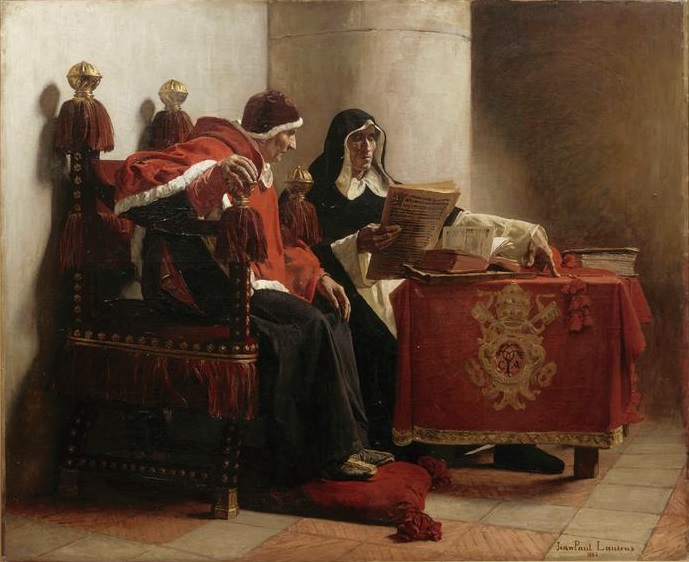
Le pape et l'inquisiteur (1882)

Pope Formosus and Stephen VII" - The "Cadaver Synod" (1870)

L'Excommunication de Robert le Pieux - 1875
Hostages. Held by the Musée des Beaux-Arts, Lyon (1896)
The Agitator of Languedoc (1887). Held by the Musée des Augustins, Toulouse.
The last moments of Maximilian, Emperor of Mexico (1882). Held by the Hermitage, St. Petersburg.
Porträtt av en kvinna (1874).
The Western Roman Emperor Honorius (1880)
La Délivrance des emmurés de Carcassonne (1879)
Faust
Intérieur du Capitole de Toulouse, painted by Laurens.
The execution of the Duke of Enghien (1873)
Salle des illustres au Capitole de Toulouse, ville de Toulouse, région Midi-Pyrénées (France) : Le Lauraguais Campagne Toulousaine
Toulouse strengthens its walls to resist Simon de Montfort in 1218 

Monday, 4 February 2013

Skeleton Found Confirmed to be Richard III

Now if you are well versed in the archaeology world, you'd know that for the past week or two, people from all walks of life (myself included) tuned in to a press conference organised by the University of Leicester. What for? 

The skeleton
On the 24th of August 2012, the University of Leicester and Leicester City Council, in association with the Richard III Society, announced that they had joined forces to begin a search for the remains of King Richard. On 5 September 2012, the excavators announced that they had identified a male body located under a public car park, many speculated this belonged to the King.

But first, you might be wondering who Richard III was.
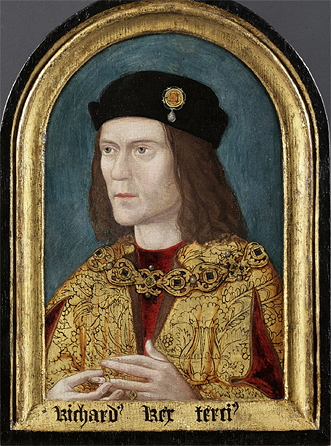
Portrait of Richard the Third

Richard III (born 2 October 1452 – died 22 August 1485) was the King of England for two years, from 1483 until his death in 1485 during the Battle of Bosworth Field. He was the last king of the House of York and the last of the Plantagenet dynasty. His defeat at the Battle of Bosworth Field was the decisive battle of the Wars of the Roses and is sometimes regarded as the end of the Middle Ages in England. He is the subject of an eponymous play by William Shakespeare (and now you know!)

In August 1485, Richard III faced Henry Tudor at Bosworth and was killed. His body was brought back to Leicester and was buried without pomp or ceremony in the church of the Grey Friars.

Back to the press conference: After a rather interesting flurry of speeches, experts from the University of Leicester said DNA from the bones recovered from the car park, matched that of descendants of the monarch's family.
Lead archaeologist Richard Buckley, from the University of Leicester, told a press conference to applause: "Beyond reasonable doubt it's Richard."
 Dr. Jo Appleby stated at the conference that the skull was struck during excavation but this did not cause major damage. There is also damage to the bones from their being buried for 500 years.
The entire skeleton, note the curved spine
It was an adult male but with an unusually slender, feminine build. That's consistent with descriptions of Richard. There is no indication he had a withered arm, however. He was aged in his late 20s to late 30s. That fits with Richard's age when he died. The skeleton was not born with scoliosis, she also said.

Among the injuries on the skeleton was a small, rectangular injury on the cheekbone, consistent with a dagger. There was a small, penetrating wound on the top of the head. This came from a direct blow from a weapon, and would not have been fatal.
A large wound to the base of the skull came from a slice cut off the skull by a bladed weapon. A smaller injury on the base of the skull was also caused by a bladed weapon. Both of these injuries would have caused almost instant loss of consciousness and death would have followed shortly afterwards. There are also three more shallow wounds on the skull. And there is a cut mark on the lower jaw, caused by a bladed weapon.

Following DNA analysis from the skeleton and from living descendents, the researchers were able to say, "beyond reasonable doubt", that it was the skeleton of Richard III.
The skeleton in its burial place, courtesy of the University of Leicester
What now for the body? Well, it's to be reburied at Leicester Cathedral.

The Deforestation of Nabih Saleh in Bahrain - in Maps!

 This post is an example of the invaluable information and data provided by the groundbreaking people at mapBH . For those unaware, mapBH is...