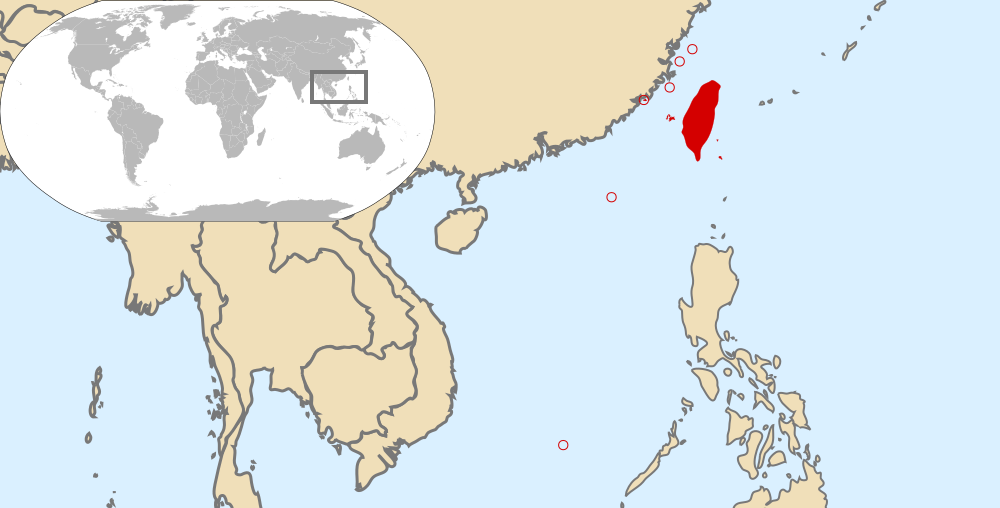
Taiwan is an island state situated in East Asia and for the much of the early half of the 20th century, the island was controlled by Japan. Following the end of World War II, the island eventually came into the control of China (though officially, the details are murky, with Japan still exercising sovereignty over the island until 1952.
See here). As a result of the Communist takeover of mainland China, the previous government relocated to Taipei in Taiwan and continue to stay there since.
During the latter half of the 20th century, Taiwan has experienced rapid economic growth and industrialization and is now an advanced industrial economy.
In the 1980s and early 1990s, Taiwan evolved into a multi-party democracy with universal suffrage. Taiwan is one of the Four Asian Tigers and a member of the WTO and APEC. The 19th-largest economy in the world,its advanced technology industry plays a key role in the global economy.
Taiwan is ranked highly in terms of freedom of the press, health care, public education, economic freedom, and human development.
Here are some photos from
TaiPics.com, which is an archive of over 7000 historical Taiwan pictures collected and organized by
taipeimarc, an American expat in Taiwan. All images are believed to be in the public domain. I recommend you visit the website!
 |
| Overview of Taipei, Taiwan's capital, in the early 20th century |
 |
| School session in Japanese-held Taiwan, prior to 1945 |
 |
| The Governor General's house and East Gate , circa 1920s. |
 |
| School gathering |
 |
| Farmers working |
 |
| 1945 bombing of Taipei |
 |
| Taipai in the early 20th century |
 |
| Taiwanese farmers on the field. Date unknown |
 |
| Girls' school in Taiwan |
 |
| Aborigines of Taiwan (historically called Formosa). Date unknown |
 |
| Missionary school, date unknown. |
 |
| Rice planting. Workers often worked till sunset. Date unknown |
 |
| Opium den in Taiwan |
 |
| Sugar manufacturing factory and plantation. The site is now a museum. |
 |
| Sugarcane farming. Date unknown |
 |
| Sugar bags from the 1940s. |
 |
| Sun Moon Lake. |
 |
| Aborigines canoeing in the Sun Moon Lake. |
 |
| Unknown building in Taipai |


5 comments:
Liked the introduction and amazing pictures you got there! Keep the amazing posts coming!
"" Following the end of World War II, the island was handed to China.""
This is incorrect. Although the two Chinese gov't claim to this day it is true, the reality is that the San Francisco Peace Treaty stripped sovereignty from Japan but awarded it to no one. Japan retained sovereignty until 1952. To this day the formal position of the US and most other western powers is that Taiwan's status awaits determination. Until the Nixon Administration it was customary for the State Dept to testify to this in the annual hearings. Nixon, to sell out Taiwan to gain Chinese support for his Vietnam policy, suppressed that practice. The State Dept won't say it out loud, but the fact remains that under international law and US policy, Taiwan's status is undetermined.
Michael
The View from Taiwan
Well this left me a bit red-faced! It's now been rectified with the explanation directed here. Thank you very much for pointing it out!
.. if I am not mistaken then the last photo here (title: unknown building ... ) shows the Governor Office Building, what is today the Office of the President ROC, on Sec. 1 Chongqing South Road.
Regards.
Andrew from Germany
Actually, Japan formally surrendered Taiwan to the Kuomintang (the Nationalist Chinese government) on October 25, 1945, which the Kuomintang interpreted as Japan's ceding of Taiwan back to China, hence "Retrocession Day" in Taiwan. The Nationalists were only interested in Taiwan as a source of raw materials to pillage in order to continue their civil war against the communists, which they lost a few years later.
Post a Comment