Showing posts with label Balkan History. Show all posts

Saturday, 14 June 2014

Feature Documentary: The Death of Yugoslavia

The Yugoslav wars of the 1990s were a chaotic era in Balkan history that saw some of the worst massacres on the European continent since the Second World War. Tackling such an issue as a documentary was more than challenging and yet, the BBC have managed to compile a compelling, insightful and, at times, surreal experience of a documentary. Released in 1995, The Death of Yugoslavia covers the breakup of the Yugoslavian Republic and the subsequent wars of independence.

The use of rare footage and actual interviews with the main players of the wars, particularly Serbian president Slobodan Milošević and the controversial president of Republika Srpska Radovan Karadžić. Due to the extensive interviews with such crucial players of the conflict, this documentary was used as evidence by the International Criminal Tribunal for the former Yugoslavia during the prosecution of parties guilty of war crimes. The documentary won a BAFTA in 1996 for Best Factual Accuracy

To people wishing to gain an insight into the Yugoslav wars, this documentary (though not perfect) is perhaps the best introduction, covering events up to 1995.

The full documentary is on YouTube but it is preferable to watch it in six parts. 

Part 1 - Enter Nationalism


 Part 2 - The Road To War


Part 3 - The Wars of Independence


Part 4 - The Gates of Hell


 Part 5 - A Safe Area


Part 6 - Pax Americana


Sunday, 17 June 2012

Ottoman Greece, Independence and the World Wars

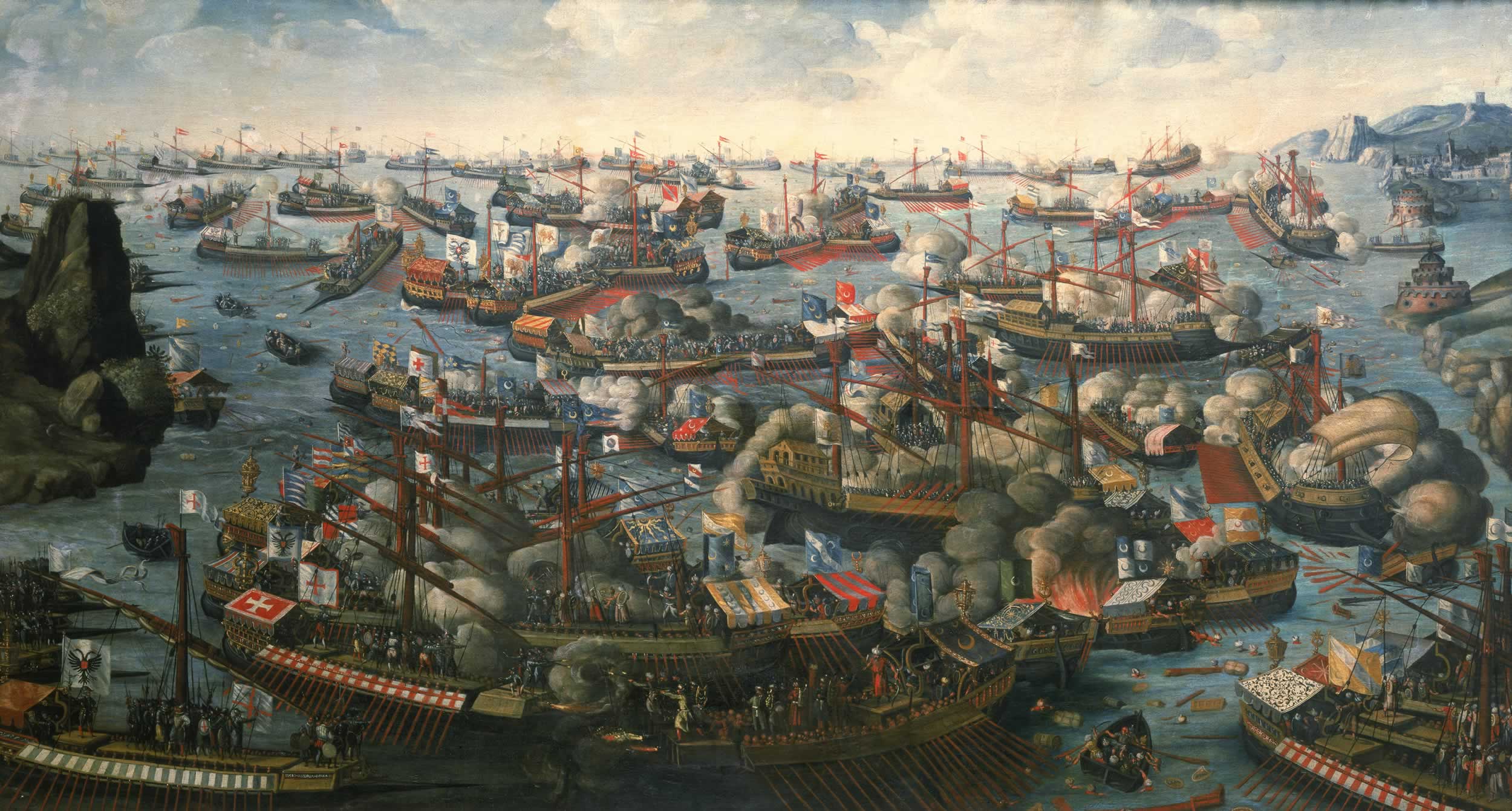
An artist's impression of the Battle of Lepanto (from National Maritime Museum)
By the start of the 1500s, much of mainland Greece and its islands were under Ottoman control, with the notable exceptions of Cyprus and Crete which were under the control of Venice (these two islands would later be conquered in 1571 and 1670 respectively). While most Greeks residing in Constantinople (the Ottoman capital) enjoyed a prosperous living, the majority of Greeks in mainland Greece were poor. This was a result of heavy taxation and an inefficient serfdom system.

In Constantinople, the Sultan recognized the Greek Orthodox Church to be the sole representative of Christians in the empire, Orthodox or not (this is evident when the Greeks were given preference over other sects in the custodianship of the Church of the Holy Sepulcher, as highlighted in an old post). Despite the Ottomans having a policy of no forced-conversions, many Christians and others converted for tax benefits.

Greeks generally had a negative feeling towards their Ottoman occupiers, participating in most wars against them. This has been notably seen in the naval Battle of Lepanto in 1571, as well as many revolts in the Great Turkish War of Europe in the late 17th century. These rebellions were quelled violently.

Greek Independence:

Greek independence movements emerged at the start of the 19th century (1814), most notably was the secret-organization Filiki Eteria , which had the main goal of achieving Greek independence and expelling the Ottomans from Greece. The Greek War of Independence kicked off on the 6th of March, 1821, initially as a revolt occurring in the Wallachia region (in present-day Romania). This revolt was successfully repressed by the Ottomans.
The flag of Filiki Eteria

News of the suppression reached Greeks in the Peloponnese (a peninsula in Southern Greece) and enraged them. On the 17th of March, 1821, Greeks in the region started rebelling. Within a month, the whole peninsula was in open revolt. Simultaneous revolts occurred in Macedonia, Crete and Central Greece, though each of these revolts were suppressed. The Ottomans, called upon Egypt (which was effectively a vassal state of the Ottomans) for aid.

In return for territorial gain, an Egyptian army was deployed to the Peloponnese in February 1825 and had immediate success: by the end of 1825, most of the Peloponnese was under Egyptian control, and the city of Missolonghi—put under siege by the Turks since April 1825—fell in April 1826. The Egyptians had succeeded in suppressing most of the revolt in the Peloponnese and Athens had been retaken.

After years of consulting with each other and intense negotiations, the European powers (Russia, France and the United Kingdom) agreed to intervene by deploying their navy to the Greek peninsula. This allied fleet clashed with the Ottoman-Egyptian fleet , resulting in the destruction of the Ottoman-Egyptian fleet. With French troops, the Greeks drove the Turks out of the Peloponnese and central Greece by 1828.

"Freedom or Death"

By 1832, the war was over via the Treaty of Constantinople (1832) and the Kingdom of Greece was established, the first Greek state since the pre-Byzantine era. It would seem appropriate that its national anthem would later be titled "Freedom or Death".

The slow but steady growth of Greece to the modern day

The rivalry between the Ottomans and Greeks did not end just yet. The Greeks were united, in their determination to liberate the Greek-speaking provinces of the Ottoman Empire. Especially in Crete, a prolonged revolt in 1866–1869 had raised nationalist fervour. When war broke out between Russia and the Ottomans in 1877, Greek popular sentiment rallied to Russia's side, but Greece was too poor, and too concerned of British intervention, to officially enter the war. Nevertheless, in 1881, Thessaly and small parts of Epirus were ceded to Greece as part of the Treaty of Berlin, while frustrating Greek hopes of receiving Crete.

Greeks in Crete continued to stage regular revolts, and in 1897, the Greek government under Theodoros Deligiannis, bowing to popular pressure, declared war on the Ottomans. In the ensuing Greco-Turkish War of 1897 the badly trained and equipped Greek army was defeated by the Ottomans. Through the intervention of the Great Powers however, Greece lost only a little territory along the border to Turkey, while Crete was established as an autonomous state under Prince George of Greece.

As a result of the Balkan War, Greece's overall territory once again increased.

World Wars:

 On the eve of WWI, the Greek government was divided between the pro-German King Constantine and the pro-Britain Prime Minister Venizelos. The division was so serious that there were two de facto governments, the King's government was based in Athens while the Prime Minister's was in Thessaloniki. In 1917, the two governments united and Greece would later enter the war on the side of the Triple Entente (the British-French-Russian side). Greece's old enemy , the Ottoman empire, was on the Central Powers' (Germany) side. Once again, the two rivals clashed.

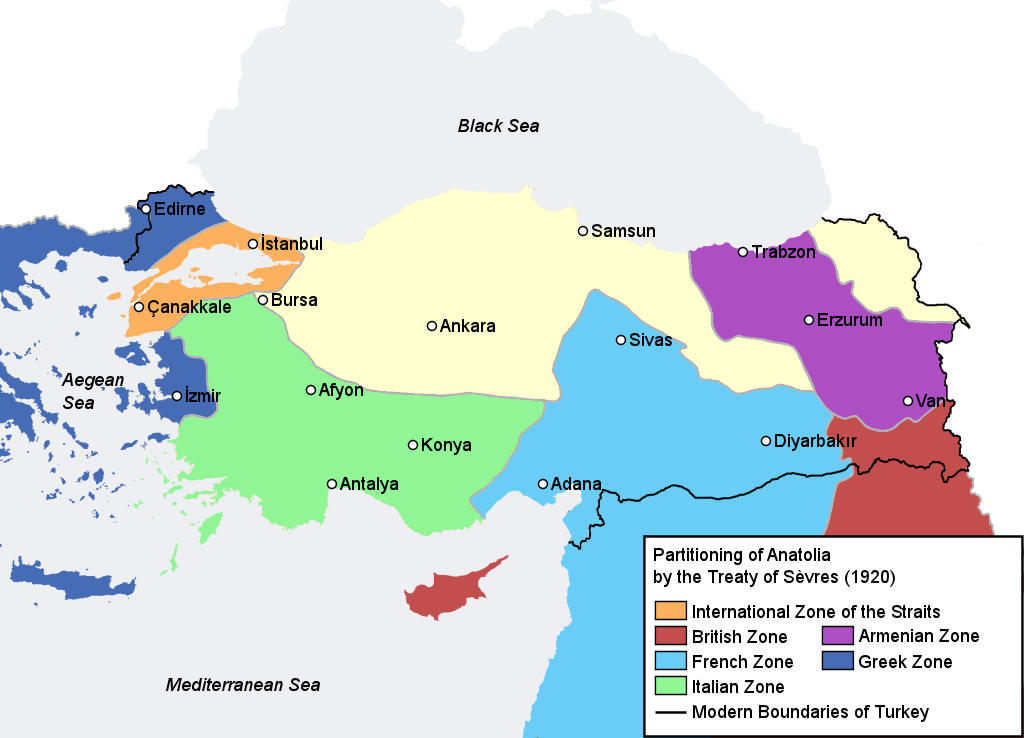
Territorial changes as stated in the Treaty of Sevres

After the war ended, the Ottoman Empire was forced to sign the Treaty of Sèvres (text here) which effectively partitioned the empire between the victorious Allies. Iraq, Syria, Palestine, and much of the Ottoman heartland of Anatolia was to be carved up by the British, Greeks, French and Armenians. The Turkish public was outraged and, under the leadership of WWI Turkish veteran Mustafa Kemal, fought a series of wars called the Turkish War of Independence. One of these wars was the Greco-Turkish War that lasted from 1919 to 1922.

The war was disastrous for the Greeks, with Greek losses amounting to almost 20,000 dead as well as over 100,000 casualties. The war ended with Greece returning to pre-war boundaries and leading both sides to exchange populations (Greeks in Turkey to Greece and vice versa). A testament to this change was that the population of Greeks in Istanbul dropped from 300,000 in 1900, to just over 3,000 currently. Over 1.5 million Greek refugees arrived in Greece.

In 1924, the monarchy was abolished via a referendum and a Second Hellenic Republic was proclaimed. Though, a decade later, the monarchy was restored once again in 1935. A coup occurred in 1936 which installed fascist elements into the government. Though it was primarily fascist, Greece was still friendly to the Allied powers and not aligned with the Axis.

German war flag being raised in Athens
On 28 October 1940 Fascist Italy demanded the surrender of Greece, but the Greek government refused. As a result, the Greco-Italian War followed and effectively saw Greece enter WWII on the side of the Allies.

Greece repelled Italian forces into Albania, giving the Allies their first victory over Axis forces on land. The country would eventually fall to urgently dispatched German forces during the Battle of Greece (Wikipedia covers it extensively here). The German occupiers nevertheless met serious challenges from the Greek Resistance. Over 100,000 civilians died from starvation during the winter of 1941–42, and the great majority of Greek Jews were deported to Nazi extermination camps By the time the war was over, over 400,000 Greeks perished (the vast majority being civilians).

After the war was over, a power vacuum emerged. The Communist party (backed by Yugoslavia, Albania and Bulgaria) wanted to rule over Greece but they were met with opposition from the 'democratic government' (backed by UK and USA). A brutal three-year civil war occurred between 1946 to 1949. Greece was one of the first theaters of the Cold War.

This distrust and tension between the two sides lasted for more than three decades and caused political polarisation. In 1965, after the Greek King dismissed the government, a coup deposed the King and ushered in a military junta. The brutal suppression of the Athens Polytechnic uprising on 17 November 1973 sent shock-waves through the regime, and a counter-coup occurred. On 20 July 1974, as Turkey invaded the island of Cyprus, the military junta regime collapsed.
Present-day Cyprus. Nicosia remains the only divided capital in the world

 On 14 August 1974 Greek forces withdrew from the integrated military structure of NATO in protest at the Turkish occupation of northern Cyprus .The first multiparty elections since 1964 were held on the first anniversary of the Polytechnic uprising. A democratic and republican constitution was promulgated on 11 June 1975 following a referendum which chose to not restore the monarchy.

Relations with neighbouring Turkey improved when successive earthquakes hit both nations in 1999,ushering in greater cooperation and leading to the lifting of the Greek veto against Turkey's bid for EU membership. In 1981, Greece joined the European Communities (a precursor to the European Union) and an economic boom followed.

Poster's comment:
That concludes the post. I felt that a country, with such a rich history, should have more positive news. I honestly wish for the best for Greece. I hope that you, dear reader, would appreciate what Greece has been through throughout its most turbulent years and I am confident, that one day, Greece will rise up again.

Saturday, 11 February 2012

Who were the Ottomans ? A Brief Introduction

Yes, apparently I'm that much annoyed by the survey's results. So I thought it's time for a real and proper introduction to the Ottomans (and hopefully, I might slim down the margin!), so let's get started !

The Ottoman insignia (they had style , no ?)
The Ottomans were, in essence, Turks. The Turks are an ethnic group that originated from Central Asia. The Ottoman Empire, in particular, started in 1299. At the time, Anatolia (which is present-day Turkey, excluding the European part) was carved up into several minor (and often warring) independent states called 'Ghazi Emirates' (or Anadolu Beylikleri in Turkish). 

The founder Osman I and his Dream:


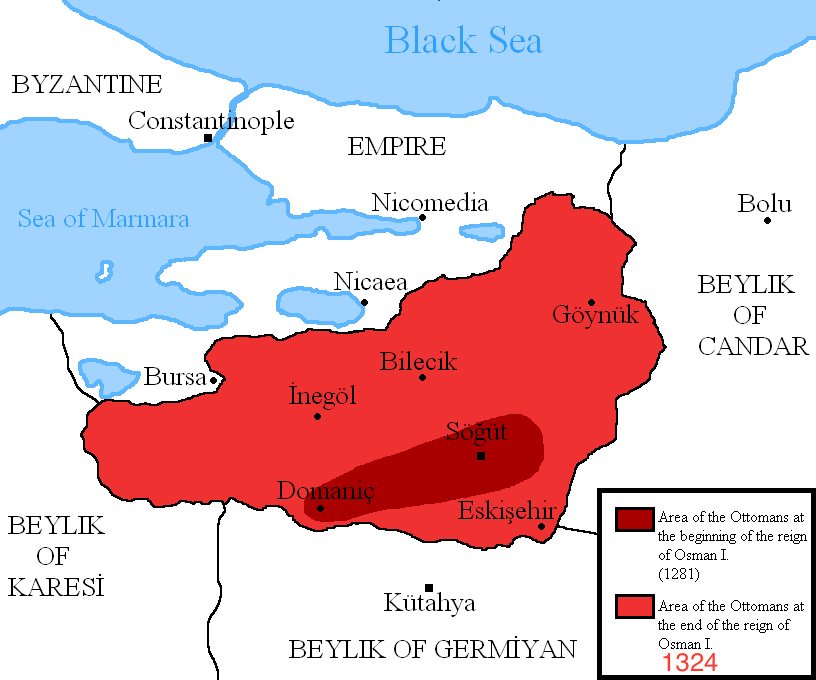
A map showing Osman I's conquests
One of these emirates was controlled by a man named Osman I (from which the word "Ottoman" is derived from), who controlled a region in western Anatolia. A popular myth about Osman was the famous "Osman's Dream" myth, in which he had dreamed of a tree which symbolized his future empire.

 According to his dream the tree, which was Osman's Empire, issued four rivers from its roots, the Tigris, the Euphrates, the Nile and the Danube.Additionally, the tree shaded four mountain ranges, the Caucasus, the Taurus, the Atlas and the Balkan ranges.

Osman set about conquering nearby areas of Anatolia and with this, the Ottomans have begun their first-minimal wave of expansion.

Expansion , Civil War and Fall of the Byzantine Empire:

The Ottomans continued to expand, non-stop, for another 200 years.

An Ottoman conquest of Thessaloniki from the Venetians secured Hellenic Thrace while a decisive battle against the Serbs at the Battle of Kosovo (1389) effectively ended Serbian influence and supremacy in the Balkan region.

The seemingly invincible Ottoman army dealt a severe blow to the Europeans at the Battle of Nicopolis in 1396 , which was known as the Last Major Crusade of the Middle Ages. The victory of the Ottomans over a pan-European army (comprising of Hungarian,Wallachian, French, Burgundian, German forces) marked the end of the Second Bulgarian Empire and lead to Bulgaria being absorbed into the Ottoman empire.

The Ottoman ,3 years before the capture of Constantinople
In 1402, the Ottomans, having now secured all former Byzantine lands around the capital Constantinople , were poised to besiege the city.

However, it was not meant to happen, yet.

At around the same time, Tamerlane's horde invaded the Ottoman territories, temporarily relieving the Byzantines.

The Ottomans suffered a humiliating defeat at the Battle of Ankara (1402) when the Sultan (Bayezid I) himself was captured (and later killed).

This led to a power-vacuum and a civil war in the Ottoman empire (imagine the relief of the Byzantines!) and it took more than a decade for the problem to be sorted when Mehmed I took power and emerged as Sultan in 1413.

During the civil war, the Balkan holdings of the Ottomans (including Thessaloniki and others) were lost. Mehmed I effectively reconquered them, Murad II (another Sultan) fended off a Hungarian-Polish alliance to drive the Ottomans out of Europe, defeating them at the Battle of Varna in 1444.
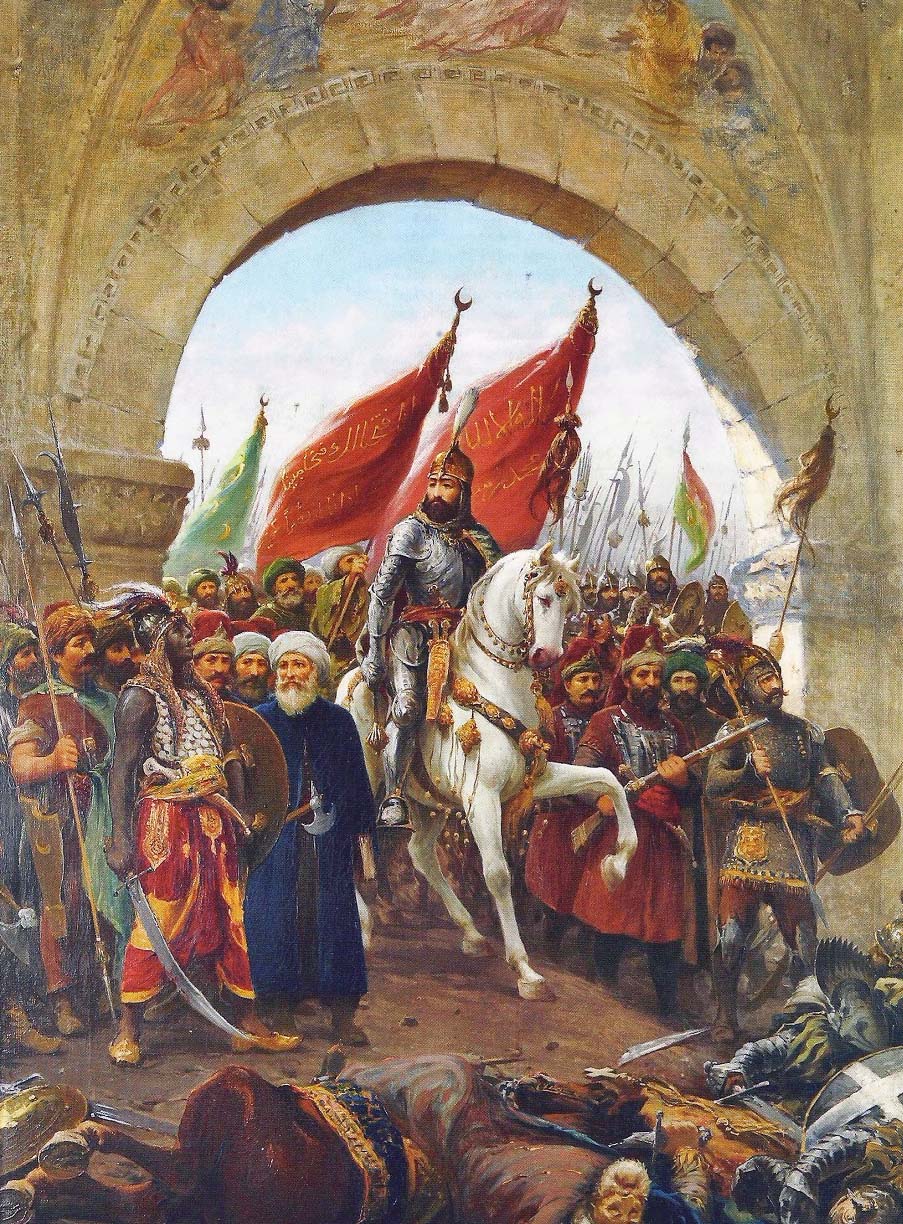
The painting shows the Fall of Constantinople

It was Murad's son, Mehmed II , who would be the greatest Ottoman leader yet. He had reorganized the state and military and proved his military ingenuity by conquering Constantinople in 1453 at the mere age of 21, effectively putting to an end, thousands of years of Roman power.

After this, the Ottomans relocated their capital to Constantinople and appropriately, Mehmed II now bears the title "محمد الفاتح‎" which means, Mehmed the Conqueror.

 Constantinople fell in 57 days. The reason was thought to have been because Mehmed had focused on strengthening the Ottoman Navy, which was to have an important role in preventing naval aid from reaching the Byzantines.

It was commonly believed that, 10 years after the siege, Mehmed II visited the site of the ruined city of Troy and boasted about how he had avenged the Trojans in their war against the Greeks.

Mehmed II also placed the title "Caesar" on himself, claiming to be descendant from the Romans (his mother was believed to have been a Byzantine princess). He had tried to conquer Rome, sending an invasion fleet to invade South Eastern Italy. This caused the Pope to panic and called for a crusade. Before reaching the invasion site, Mehmed died and the invasion failed.(In fact, he was the Sultan who had fought off Prince Vlad III the Impaler, otherwise popularly known as Count Dracula!)

Peak of Ottoman Power:

This map explains the extent of Ottoman Expansionism
It would be obvious what the Ottomans had achieved now. By capturing Constantinople, they've consolidated their role as being a Mediterranean power. Anatolia was finally conquered by Beyezid II in 1482. His successor, Selim I, conquered modern-day Syria, Lebanon, Jordan, Palestine and Egypt as well as securing Baghdad (temporarily) from the Safavids in the 1510s. After the conquest of Cairo, the Sultan took up the title "Caliph".

Suleiman the Magnificent 's reign followed, in which he expanded the Balkan frontier ; capturing Belgrade and most of Hungary as well as Rhodes. He had also annexed huge parts of Northern Africa (see Libya and Algeria), and had granted the Barbary pirate states of Tripolitania , Tunisia and Algeria, autonomy.

He had also expanded into the Persian Gulf region, turning the local states into Vassal states and maintaining an Ottoman naval presence there until the Portuguese expelled them in 1554. A siege on Vienna (Austria) was laid in 1529 but failed.

By the end of Suleiman's reign, the Ottoman Empire housed 15 million people.

The Ottomans, since they controlled major overland trade routes, had a monopoly over trade products in Europe. However, with the advent of the discovery of the new world and subsequent findings of raw materials and gold, this caused severe inflation in the Ottoman economy. The Ottomans retaliated against aggressive European expansionism , primarily in the form of the Portuguese and Spanish navies.

Decline:

The Ottoman Navy suffered their most humiliating defeat, beaten at the Battle of Lepanto against the Holy League (a confederation of Catholic States). Though, this had little tactical significance, this victory symbolized that the Ottoman Navy was not invincible. The Ottomans could be beaten.

As times changed, reliance on firearms grew more and cavalry importance became less. Though the Ottomans were slightly behind the arms race, the Ottomans replaced their secret weapon , the Sepahi cavalry, with an even more frightening corps that striked fear into the Europeans; the Jannisaries.

The Ottomans faced the onslaught of the Holy League once again, in the Balkan frontier. Fifteen (15) continuous years of war culminated in the Treaty of Karlowitz (1699) which lead to the Ottoman Empire to surrender Hungary permanently to the Holy League.
Battle of Lepanto painting

Besides a constant changing of hands in the city of Baghdad and Yerevan, very little happened on the eastern front with the Safavids.

As the 18th century arrived, the Ottomans gave more land to the Austrians as a result of war. Soon, Algeria and Egypt were independent in all but name (but came under the influence of France and UK respectively). The Ottomans had to face a new growing challenge - The Russian Empire. Sweden's ruler Charles XII, managed to convince the Ottoman Sultan to declare war on the Russians (in order to help the Swedes). The Ottomans were largely successful and ended in an Ottoman victory.

During the Tulip Era (1718–1730), named for Sultan Ahmed III's love of the tulip flower and its use to symbolize his peaceful reign, the Empire's policy towards Europe underwent a shift. The Empire began to improve the fortifications of its cities in the Balkan peninsula to act as a defence against European expansionism.

Cultural works, fine arts and architecture flourished, with more elaborate styles that were influenced by the Baroque and Rococo movements in Europe. A classic example is the Fountain of Ahmed III in front of the Topkapı Palace. The famous Flemish-French painter Jean-Baptiste van Mour visited the Ottoman Empire during the Tulip Era and crafted some of the most renowned works of art depicting scenes from daily life in the Ottoman society and the imperial court

After the Crimean War (fought in the Crimea region of Ukraine, and involving the Ottomans), the Ottomans were inevitably going to fall.

The spread of Nationalism, secessionism (particularly in the Balkans) and the Reform movement (ie, the Tanzimat era) led to the downfall of the Ottomans. The Ottomans were a multi-ethnic empire where differences were bound to be obvious ; the government had tried to impose Ottomanism, where all Ottoman subjects were viewed as equals (perhaps a response to the French Revolution as well ?).

The Empire is Dead. Long Live the Republic:

World War One was the killing blow. The Ottomans, having aligned with the Central Powers, faced a double frontier; one in the Caucuses against the Russians, and one in the Sinai frontier against the British (and briefly, a front in Gallipoli and in Iraq, both of which failed). The Russian theater was particularly a bloody one.

The Mesopotamian Theater
The Great Arab Revolt of 1916 (the brainchild of British negotiations with the Sharif of Mecca) was the turning point in the Middle Eastern theater. Jordan, Palestine, Iraq and Syria was lost by 1918. In 1919, under the Treaty of Sèvres, the dissolution of the Ottoman Empire was solidified. For the first time in 600 years, foreign soldiers of an enemy army occupied Constantinople in 1918.

The Turks were furious , guess why ?

The Turks were furious, their land was being carved up by foreign powers and there was one Turk who didn't stand for this. Mustafa Kemal (Ataturk was a later title), a soldier of the former Ottoman Army who served in Gallipoli, he had lead the Turkish War of Independence against the foreigners.

First, the revolutionary army went to war against the newly-founded Armenian state which culminated to the Treaty of Alexandropol (December 2, 1920) which nullified the state. Attention was turned to the Greeks and their land was won again.

The Greek campaign was launched because the western Allies, particularly British Prime Minister David Lloyd George, had promised Greece territorial gains at the expense of the Ottoman Empire. It ended with Greece giving up all territory gained during the war, returning to its pre-war borders, and engaging in a population exchange with the newly established state of Turkey under provisions in the Treaty of Lausanne.

The collective failure of the Greek military campaign against the Turkish revolutionaries, coupled with the expulsion of the French military from the region of Cilicia, forced the Allies to abandon the Treaty of Sèvres. Instead, they negotiated a new treaty at Lausanne. This new treaty recognised the independence of the Republic of Turkey and its sovereignty over East Thrace and Anatolia.

Painting showing the capture of Ismir
As one Turkish poet said  ;

The war was over. 
The Empire was dead.
The Republic lived on.
If the above article is unclear, I direct you to this colourful map!

Understood now ? :)


Friday, 6 January 2012

Freshen Up With Archaeology Friday (Post III)

Lots have been going on in the past week so let's get down to it.


Orcadian temple predates Stonehenge by 500 Years:

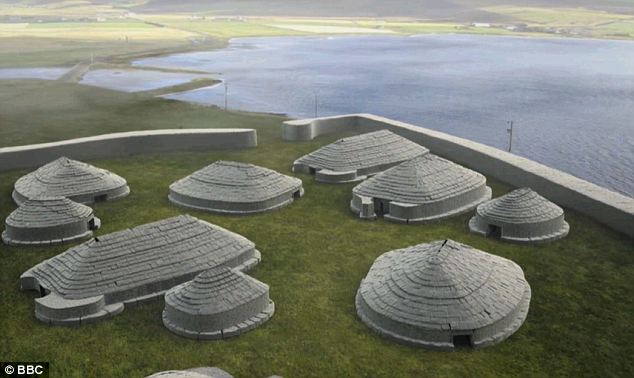
Archaeologists have discovered a Stone age temple on the island of Orkney (to the north of Britain) that seems to predate the legendary Stonehenge!

A computer model of the site (from the BBC)
Archeologists have so far found undisturbed artefacts including wall decorations, pigments and paint pots, which are already increasing their understanding of the Neolithic people.

Experts believe the huge outer wall suggests the site was not domestic, while the layout of the buildings has reinforced the view it might have been a major religious site. Archaeologists think the temple was built 500 years before Stonehenge, regarded as the centre of Stone Age Britain.

However, only 10% of the site at Ness of Brodgar has been excavated and it could be years before the scale and age of the discovery is fully understood.
 It sits close to the existing Ring of Brodgar stone circles and the standing stones of Stenness, near to the town of Stromness.

The uncovered wall around the edges of the site was built with 10,000 tonnes of quarried rock and may have been up to 10 ft high.
Thermal technology also indicates the site could cover the same area as five football pitches, with some parts potentially older than Stonehenge, in south-west England, by as much as 800 years.

Charcoal samples from beneath the wall indicate it was built around 3200 BC. A 30mm high figurine with a head, body and two eyes, and called the "Brodgar Boy", was also unearthed in the rubble of one of the structures.

About 18 months ago, a remarkable rock coloured red, orange and yellow was unearthed. This is the first discovery in Britain of evidence that Neolithic peoples used paint to decorate their buildings.

Project manager Nick Card said the discoveries are unparalleled in British prehistory and that the complexity of finds is changing the "whole vision of what the landscape was 5000 years ago." He said it was of "a scale that almost relates to the classical period in the Mediterranean with walled enclosure and precincts".
Mr Card added: "It's a huge discovery; in terms of scale and complexity there really is nothing else quite like it.

Archaeologists Excavate Legendary City of Dan:

According to the Biblical account, ancient Israel established one of its great temples in the city of Dan. And here, late Neolithic people first settled as early as 4500 B.C.E., and Bronze Age inhabitants constructed the world’s oldest known gated archway.

Known today as Tell el-Qadi, more popularly as "Tel Dan", the site is located near Mount Hermon in Northern Israel adjacent to one of the sources of the Jordan River. The 'Tel', or mound, was defined very early on during the Middle Bronze period when massive defensive ramparts were constructed, encircling the city.
One of the iconic ramparts (now ruined) of Dan

Although the ramparts rise about 20 meters from the surrounding surface area, the interior of the site is actually as much as 10 meters lower than the tops of the ramparts. It was first identified based on historical records as the city of Laish, a town allied with the Phoenician Sidonians and later renamed "Dan" after the early Isrealite tribe of Dan, which conquered and settled it as documented in the Book of Judges.

Thanks to a bilingual Greek and Aramaic inscription found at the site in 1976, this city name has been confirmed. Translated, that inscription reads, “To the God who is in Dan, Zoilos made a vow.”

Ancient Egyptian texts and cuneiform tablets from Mesopotamia document Dan’s significance during the second millennium B.C.E.  Later, during the Iron Age, Aramaeans, Israelites, and Assyrians fought over this city. Dan was a recognized cultic center even into the Greco-Roman period.

Although the site was first identified by Edward Robinson in 1838, the best known excavations of the site began in 1966 under the late Israeli archaeologist Avraham Biran, and it was under his direction that the most spectacular discoveries were made. His team of excavators uncovered a mud-brick city gate (pictured right) dated to around 1750 BCE (the Middle Bronze period), the time of the Biblical patriarchs.

It is popularly known as Abraham's gate because, according to the Biblical account, Abraham journeyed to Dan to rescue his nephew Lot. They also uncovered an Israelite temple, thought by Biblical scholars to be the temple built by Jeroboam, King of Israel after the United Monarchy split into Israel in the north and Judah to the south.

It was this temple where, according to the Bible, he housed the golden calf and challenged the temple in Jerusalem as a religious center of Israel. Additionally, an elaborate Israelite gate was discovered, consisting of an upper gate and a lower gate, each featuring inner and outer gates and plazas.

Arguably the most sensational find, however, was the discovery of parts of a basalt stone stele bearing an inscription containing a declaration by a king of Damascus (possibly Hazael, c. 840 BCE, or Ben-Hadad, c. 802 BCE). Translated, it proclaims his military victory and destruction of at least some parts of the Kingdom of Israel, and the killing of two kings of Israel.

Notably, it contains the phrase "House of David" ["......and I killed [Ahaz]iahu son of [Jehoram kin]g of the House of David"], a phrase rarely, if at all, seen in any extra-biblical context. Today, many Levantine archaeologists and scholars agree that it refers to a royal dynasty of David and that the Tel Dan Stele therefore represents tangible evidence that there was indeed a "kingdom", or royal dynasty, of David.

For more pictures and information, they are available here

Greatest Mystery of Incans was their Strange Economy:

I'd like to keep this part short. This is an extract from this article (Greatest Mystery of the Incans), follow the link for more information if you'd like.

In the fifteenth and sixteenth centuries, the Inca Empire was the largest South America had ever known. Centered in Peru, it stretched across the Andes' mountain tops and down to the shoreline, incorporating lands from today's Colombia, Chile, Bolivia, Ecuador, Argentina and Peru - all connected by a vast highway system whose complexity rivaled any in the Old World. Rich in foodstuffs, textiles, gold, and coca, the Inca were masters of city building but nevertheless had no money.

In fact, they had no marketplaces at all.

The Inca Empire may be the only advanced civilization in history to have no class of traders, and no commerce of any kind within its boundaries. How did they do it?

Many aspects of Incan life remain mysterious, in part because our accounts of Incan life come from the Spanish invaders who effectively wiped them out. Famously, the conquistador Francisco Pizzaro led just a few men in an incredible defeat of the Incan army in Peru in 1532. But the real blow came roughly a decade before that, when European invaders unwittingly unleashed a smallpox epidemic that some epidemiologists believe may have killed as many as 90 percent of the Incan people.

Our knowledge of these events, and our understanding of Incan culture of that era, come from just a few observers - mostly Spanish missionaries, and one mestizo priest and Inca historian named Blas Valera, who was born in Peru two decades after the fall of the Inca Empire.

Scientists say Shroud of Turin was created by ultraviolet lasers!

Perhaps the jaw-dropper headline of the Archaeology world, certainly no one was prepared to hear this!
The shroud of Turin (positive and negative comparison)

The exact origins of the Turin Shroud remain a great mystery, but scientists are now disputing the long-held belief that the religious artifact is a medieval forgery.

Italian researchers at the National Agency for New Technologies, Energy and Sustainable Economic Development say they believe the image was created by an ultraviolet "flash of light." However, if that theory is true, it remains a mystery as to exactly how that technology could have been implemented at the time of the Shroud's creation. While the technology is readily available in present day, it was far beyond the means of anyone around pre-20th Century.

The Turin Shroud is said to be the burial cloth of Jesus, but has long been believed to be a fake, created during medieval times. It is currently kept in a climate-controlled case in Turin cathedral. Scientists at the Italian agency have reportedly spent years attempting to recreate the Shroud's imagery.
'The results show a short and intense burst of UV directional radiation can colour a linen cloth so as to reproduce many of the peculiar characteristics of the body image on the Shroud of Turin,' the scientists said.

"When one talks about a flash of light being able to color a piece of linen in the same way as the shroud, discussion inevitably touches on things such as miracles," said Professor Paolo Di Lazzaro, who led the study. "But as scientists, we were concerned only with verifiable scientific processes. We hope our results can open up a philosophical and theological debate."


Believers in the Shroud say it contains the image of a man with nail wounds to the wrist and feet. Still, skeptics of the Shroud's authenticity are unlikely to be swayed. There has been substantial evidence working against it, including a 1988 radiocarbon test conducted at the University of Oxford, which dated the cloth to a time between 1260 and 1390.

Infamous 'Yeti Finger' is a Fraud:

A finger long claimed to be from a yeti, once revered in a monastery in Nepal and taken in the 1950s by a Bigfoot researcher, has been identified after decades of mystery. Turns out, it's just a regular old human finger — albeit one with a very interesting history.
The Mysterious Finger (photo from the Daily Mail)

The yeti is said to be a muscular beast weighing between 200 and 400 pounds and covered with dark grayish or reddish-brown hair. As in the case of its North American counterpart, Bigfoot, most of the evidence of its existence comes from fuzzy sightings, oversize footprints in the snow, or the occasional strand of funny-looking hair.

But there has been one interesting piece of physical evidence of the yeti: a finger that was either bought or stolen from the Pangboche Buddhist monasteryin the 1950s, depending on which disputed story you believe. It has been in London, among the collection of the Royal College of Surgeons, for more than half a century.

The finger was taken from the monastery by Bigfoot researcher Peter Byrne and was smuggled out of the country, so the story goes, by beloved Hollywood actor Jimmy Stewart, who hid it amid his wife's lingerie. The monstrous finger ended up in the possession of Dr. William Osman Hill, who had searched for the yeti in the 1950s on behalf of Texas millionaire Tom Slick; Hill later bequeathed the finger to the Royal College of Surgeons.

The finger has generated controversy among Bigfoot and yeti believers for decades and, until relatively recently, when researchers at the Edinburgh Zoo performed DNA analysis on the mysterious digit, it was impossible to know for certain what kind of animal it belonged to. [Mythical Beasts That Might Actually Exist]

If it is indeed a Yeti finger, then the mysterious beast is even more man-like than anyone imagined. According to the researchers' DNA analysis, the Yeti finger is human, perhaps from the corpse of a monk. But definitely human.
Rob Ogden of the Royal Zoological Society of Scotland explained to BBC News: "We had to stitch it together. We had several fragments that we put into one big sequence, and then we matched that against the database and we found human DNA." The researchers said that the result “wasn’t too surprising, but obviously slightly disappointing.”

It is not the first yeti claim to be debunked by science. In 1960 Sir Edmund Hillary, the first man to scale Mount Everest, searched for evidence of the beast and found a "scalp" that scientists later determined had been fashioned from the skin of a serow, a Himalayan animal similar to a goat.

Earlier this year a team of researchers in Russia claimed to have found "indisputable proof" of the yeti, though so far the evidence has fallen far short of the claims. If populations of yetis really exist, they, like Bigfoot, have somehow managed to avoid leaving any physical traces of their presence: bodies, bones, teeth, hair, or anything else.

NATO: Libyan Heritage Sites survive because of "No Strike" list:

Earlier this week (actually, two days ago), NATO released a report about its operations in Libya with regards to the UNESCO heritage sites, claiming that the sites were relatively unscathed from the Libyan Civil War,due to a strict 'No Strike' list adopted by the military alliance.

The report says:
During the conflict in Libya there were allegations that pro-Qadhafi troops and missiles were being hidden in the ancient city of Leptis Magna and that Qadhafi was using it as an archaeological shield.
With such explosive storage, the risk of damage was great, but the sites of Leptis Magna and Sabratha have survived the conflict unscathed. That is excellent news for the cultural heritage of Libya and the tourism industry that the nation hopes to resurrect.
Conflict is not the only threat to ancient artefacts. There is also the risk that a breakdown in law and order can give criminals the opportunity to steal items of great significance. In perhaps the worst case of looting during the conflict, nearly eight thousand ancient gold, silver and bronze coins, as well as a small number of artefacts, were stolen from a Benghazi bank vault.
In some areas documentation, archiving and cataloguing was never carried out, making it difficult to estimate the loss to Libya’s cultural heritage. But, by and large, Libya seems to have avoided the kind of cultural looting and vandalism that occurred after the invasion of Iraq.
In a first of its kind initiative, two men were instrumental in setting up a ‘No Strike List’ of heritage and cultural sites that should be preserved in the conduct of air operations. They were Karl Von Habsburg, President of the ‘Blue Shield Committee’ in Austria and Dr Joris Kila, teacher at the University of Amsterdam and Chairman of ‘The International Military Cultural Resources Work Group’.
They have now returned to make an assessment of the damage inflicted by the conflict on Libya’s heritage. “We both know the importance to be fast and in a place where there is a potential conflict or an actual conflict,” says Karl, “you have to be there really fast to make an assessment and to see what you can do to immediately help.”
The two have been granted special access to sites that several months earlier had been welded shut for protection, a practice both experts agree is critical to protect heritage in times of unrest. While it works for museums, protecting sites like Leptis Magna and Cyrene in wide-open spaces is a lot more difficult.
The work they are undertaking fills the gap in the protection of heritage sites until the Libyan Government is able to take over. “We hope that we will encourage them to take over part of our duties,” says Joris, “and do the work that has to be done.”
Some of the sites they visited had been in close proximity to air strikes and escaped with only cosmetic damage. “It seem like our no strike list with cultural sites was very effective,” Joris notes, “because we didn’t find serious damage with bombardments by NATO on cultural sites.”
Libyan archaeologists and historians can now breathe a sigh of relief that their heritage is still safe and secure.

2,000-year-old relief bust found in Stratonikeia, Turkey:

A picture of the bust (Photo from AA)

A 2,000-year-old relief bust of a king was discovered during excavations in ancient Stratonikeia in Muğla's Yatağan district.
Dr. Bilal Söğüt, a professor of archeology at Pamukkale University and head of the excavations, told the Anatolia news agency that they found a street in the ancient city which began with a gate and was lined with columns. During their excavations, they also discovered the bust of a king dating back to the Hellenistic period. The bust, which is one-and-a-half meters tall and nearly two meters wide, features depictions of bull heads and the figure of a goddess, Söğüt said.


“The depictions of bull heads on the bust represent wealth and power. It was in this region that we previously found a racing chariot. The discovery of 1,500-year-old mosaics here was another welcome breakthrough for us,” he said.


According to Söğüt, the city walls constitute an important part of the excavation work carried out in the ancient city. “The city walls were restored approximately 2,400 years ago by King Mausolus. We have begun excavating these 2,400-year-old walls of this ancient city. Upon the completion of the excavations, we will start work on restoring the area,” he said.

Söğüt said he thinks the walls surrounding the ancient city are nearly 3,600 meters long.

“We discovered that one 400-meter section of wall has been preserved to this day. After completing restoration, we will open the wall to visitors," Söğüt said.

A 100-person team of academics, field workers and students discovered 460 artifacts in the ancient city in the seven-month-long excavations that took place last year, according to Söğüt. The artifacts were delivered to the Muğla Museum. The pieces date back to the Roman and Byzantine periods, he said.

Civil War-era wreck off Egmont Key to become preserve:

A Civil War-era ship that participated in one of the nation's most famous naval battles before sinking in the mouth of Tampa Bay is set to become Florida's 12th underwater archaeological preserve.

The wreck of the USS Narcissus tugboat off Egmont Key just north of Anna Maria Island "provides not only a fascinating underwater preserve to explore, it also offers a unique and adventurous look into our nation's naval history," Florida Secretary of State Kurt Browning said this week in announcing the nomination.
A part of the wreckage (Photo from Herald Tribune)

Built in East Albany, N.Y., in 1863, the Narcissus steamed south in January 1864 to support the Union Navy's blockade of Confederate shipping routes, according to a report complied by state researchers.
The ship was involved in operations from New Orleans to Pensacola, but its most famous engagement came during the Battle of Mobile Bay on Aug. 5, 1864.

The union fleet's victory at Mobile Bay captured a key Confederate port and lived on in popular culture thanks to the "Damn the torpedoes!" command attributed to Rear Adm. David G. Farragut as he urged his ships forward against an array of defenses.

The Narcissus was ordered to return north for sale after the war but sank in 1866 off Egmont during the journey, killing the entire crew. Once almost completely buried in sand, the shipwreck reemerged in recent years about 15 feet below the surface, according to the state report.

A 2006 archaeological expedition reported "all of the steam machinery, propeller, propeller shaft, pillow block, boiler pieces, and a portion of the wooden hull were exposed."

Lovers' Pipe Dreams Emerge from Jerusalem Excavation:

An interesting find from Jerusalem, once again !

The pipe, in all its glory !
An archaeological excavation in the Jewish Quarter of Jerusalem has uncovered a centuries-old clay pipe inscribed with the phrase "Love is the language for lovers."

Literally translated, the inscription reads "Heart is language for the lover." And, not surprisingly, it was most likely a gift to a lover, according to Shahar Puni, of the Israel Antiquities Authority.

"Clay pipes of this kind were very common in the Ottoman period, were mostly used for smoking tobacco, and some were even used to smoke hashish," Puni said in a statement. Hashish comes from the cannabis plant, like marijuana.

During this period, from the 16th to the 19th century, Jerusalem was part of the vast Ottoman Empire, a Turkish state that reached into Asia, Africa and Europe.

"The Ottoman authorities tried to combat this practice [smoking] but failed when it became clear that smoking was firmly entrenched in all levels of society. Pipes were also used as a piece of jewelry that could be worn on a garment, and smoking itself was popular amongst both men and women," Puni said.

Jerusalemite women are shown smoking clay pipes similar to this one in 19th-century drawings. Smoking was often done in cafes and with groups of friends, according to the Israel Antiquities Authority. 
_________________________________________________________________________________

And that's a wrap up for this Friday. See you next Friday !

Update:
Just hot off the presses and I thought it would be worthwhile to share.

Financial Crisis grips Bosnia Heritage sites:

To the average history-buff, it is of no doubt that Bosnia houses some of the wonders of the Balkan region (and has seen way more than its fair share of turmoil ). This from the BBC:

Reading rooms in Bosnia-Hercegovina's National Library have opened without heating as a funding crisis grips the divided country's heritage sites.

The institution in the capital Sarajevo is unable to meet its utility bills or pay its staff, deputy director Bedita Islamovic told the BBC News website.

Heating was switched off as the temperature hovered just above zero.
Other cultural institutions have closed completely as a result of disagreement over who should pay for their upkeep.

The Dayton peace agreement which ended the 1992-95 war split the country into two parts, linked by a weak central government.

The central government has no ministry of culture and no obligation to provide permanent funding for sites regarded as part of Bosnia-Hercegovina's national heritage.

Bosnian Serbs largely oppose giving the central government control over the sites, with their politicians arguing that each of the country's ethnic groups should care for its own heritage.

Bosnia's cultural breakdown

  • No central culture ministry
  • Bosniak-Croat Federation has a culture and sports ministry
  • Bosnian Serb Republic has an education and culture ministry
So deep are the continuing divisions that it has taken the sides 14 months to agree on the make-up of a new central government, after elections in October 2010.

This week, the Historical Museum closed and the National Gallery shut its doors early in the autumn.
The National Museum expects to close piece by piece in coming weeks as its power supply is cut off due to unpaid bills, director Adnan Busuladzic told the Associated Press news agency.

"By no will of our own, we have found ourselves in the middle of a political battle and have become a political problem," he said.

Among other things, the National Museum's collection includes the Sarajevo Haggadah, an illuminated manuscript brought to Bosnia by a Jewish family expelled from Spain during the Inquisition and saved from Hitler's forces during World War II.

The culture minister of the country's Bosniak-Croat Federation, Salmir Kaplan, reportedly pledged his government would provide funding to cover the unpaid utility bills of the National Museum.
However, he admitted this was just a temporary solution, AP says.

The Bosnian Serb Republic (Republika Srpska) has a culture ministry of its own.

Thursday, 29 December 2011

Explaining the complexity of Republika Srpska and the Bosnian War


Republika Srpska, in blue
For those of you who don't know, the 90s has seen the dissolution of Yugoslavia into several successor states, one of which was the Republic of Bosnia & Herzegovina, as well as Serbia.

Bosnia comprised of 43% Muslims (calling themselves Bosniaks), 31% Bosnian Serbs and 17% Croats, in the 1991 census.

A referendum for independence was boycotted by the Bosnian Serbs (who were against secession from Serbia, then-considered the main successor of Yugoslavia).

Violence ensued.


Following the declaration of independence, Bosnian Serb forces, supported by the Serbian government of Slobodan Milošević and the Yugoslav People's Army (JNA) attacked the Republic of Bosnia and Herzegovina in order to secure Serbian territory and war soon broke out across Bosnia, accompanied by the ethnic cleansing of the Bosniak population, especially in Eastern Bosnia.

It was principally a territorial conflict, initially between the Serb forces mostly organized in the Army of Republika Srpska (VRS) on the one side, and the multiethnic Army of the Republic of Bosnia and Herzegovina (ARBiH) which was largely though not exclusively composed of Bosniaks, and the Croat forces in the Croatian Defence Council (HVO) on the other side

. The Croats also aimed at securing parts of Bosnia and Herzegovina as Croatian. The Serb and Croat political leadership agreed on a partition of Bosnia with the Karađorđevo and Graz agreements, resulting in the Croats forces turning on the Army of the Republic of Bosnia and Herzegovina and the Croat-Bosniak war.The war was characterized by bitter fighting, indiscriminate shelling of cities and towns, ethnic cleansing, systematic mass rape and genocide mostly led by the Serb forces. Events such as the Siege of Sarajevo and the Srebrenica massacre would become iconic of the conflict.

The Serbs, although initially superior due to the vast amount of weapons and resources provided by the JNA eventually lost momentum as Bosniaks and Croats allied themselves against Republika Srpska in 1994 with the creation of the Federation of Bosnia and Herzegovina following the Washington agreement.

After the Srebrenica and Markale massacres, NATO intervened during the 1995 Operation Deliberate Force against the positions of the Army of Republika Srpska, which proved key in ending the war. The war was brought to an end after the signing of the General Framework Agreement for Peace in Bosnia and Herzegovina in Paris on 14 December 1995.

Peace negotiations were held in Dayton, Ohio, and were finalized on 21 December 1995. The accords are known as the Dayton Agreement. A 1995 report by the Central Intelligence Agency found Serbian forces responsible for 90 per cent of the war crimes committed during the conflict. 

As of early 2008 the International Criminal Tribunal for the former Yugoslavia had convicted 45 Serbs, 12 Croats and 4 Bosniaks of war crimes in connection with the war in Bosnia. The most recent research places the number of killed people at around 100,000–110,000 and the number displaced at over 2.2 million,making it the most devastating conflict in Europe since the end of World War II

The horrific aspect of the war was because of the intentional ethnic cleasnsing of the Bosniak ethnic group (usually Muslims).
----------------------------------------------------------------------------------------------------------
A few months ago, I had the good fortune of meeting a man from the Balkans, a Bulgarian, who helped me understand just how complex and horrific the 90s has been for the Balkans.

Here is a transcript of his explanation to me:

Me: What is Republika Srpska ? Is it a country ?

Ans: No it is not a different country. It is a political entity, a seperate zone from the Bosnians. Bosnian Serbs live there with different parliment, with their own president and prime minister, seperated from the bosnians.
In the near past Bosnians and bosnian serbs had quite a "disagreement", such a great disagreement it was, that it costed the lives of many. As you might now also Bosnians are mainly Muslims, while bosnian serbs are orthodox christians.

The future of Srpska ? It hang in Bosnia only under threat of foreign force. Bosnia Herzegovina is basically an EU protectorate with an EU governor appointed to watch over it with right to disband Bosnian institutions and veto any national legislation.

Serbs in Republica Serpska probably wish to unite their country with Serbia.

Republica Serbska was created as a result of breakup of Yugoslavia and following civil war. On territory of Bosnia Hercegovina lot of Serbs was living. Up to 40% of its population probably. When Bosnia declared independence from Yugoslavia, these Serbs disagreed with it and wanted to stay in Yugoslavia. They therefore in turn declared their independence from Bosnia. War erupted. 

He explained how all the ethnic groups were divided and scattered around
 Me: So it is all a matter of maps ? Everyone is scattered around ?


Ans: Was. War changed that. People fled or were forced out of territories controlled by other people in to territories controlled by their own.

Me: What about the Croatians ? What part did they play ?

Ans:   At first Croats allied with Serbs against Bosnians, then Croats allied with Bosnians against Serbs. Temporary alliances were rampant at the time. It was practically everyone for himself

Me: So its just ethnicity and nationalism clashing together ?

Ans: To put it in a nut shell, yes. Nationalism is one of the arguments used by power to convince people and make them hate each other.It succeeds when education fails.

The Deforestation of Nabih Saleh in Bahrain - in Maps!

 This post is an example of the invaluable information and data provided by the groundbreaking people at mapBH . For those unaware, mapBH is...