Saturday, 17 June 2017

Bilad al Qadeem in 1908 - A Brief History Of A Bahraini Village

The Gazetteer of the Persian Gulf, Oman and Central Arabia (abbreviated Lorimer, after its author) is one of the more remarkable by-products of British colonial intelligence-gathering. I've already spoken about it in great detail in prior posts but would like to re-emphasise the importance to historians (and amateur history geeks) that this document presents. It showcases a Domesday book (much like that of the Normans) written from a colonial British point of view of much of the Arabian peninsula, highlighting histories (finished in 1915) and major/minor geographical settlements  (finished in 1908) from the then-large towns of Manama and Muharraq to small hamlets spread across the plains of Arabia.

As you can imagine, I will delve into a series of posts about the entries of Bahrain's villages in the Gazetteer to appreciate an idea or snapshot of what the Bahrain of 1908 really looked like back then & in turn help understand the history of Bahrain. I will start with Bilad al Qadeem because it's literally the oldest and I feel that maybe we owe it that much.


Bilad al Qadeem
A large scattered village on Bahrain Island about 1.5 miles southwest of Manama fort. It consists of 350 mud & red huts, along with the ruins of many well-built houses. 
There is a south-western suburb called Bilad-al-Rafi (بلاد الرفيع) and the ground on the northwest side of the village, called Suq-al-Khamis (سوق الخميس), is the scene of a largely attended market which is held every Thursday throughout the year. 
About half a mile west of the existing habitations are the ruins of the Madrasah Abu Zeidan (مدرسة ابو زيدان) mosque*, with two slender and not inelegant minarets, 70 feet high, still standing; in combination with Jebel Dukhan, these minarets form the leading mark for vessels entering Manamah harbour. 
The Khamis Mosque (likely the Abu Zeidan too)
In the midst of the ruined part of the village is the Abu Zaidan spring, over which is built a modern Shia'h mosque, its beautifully clear waters fill a tank to which all the notabilities of Bahrain resort for hot bathing in the hot weather. 
The people of Bilad-al-Qadim are Baharnah who gain a livelihood as pearl merchants, cultivators and tailors. Livestock include 21 donkeys and 7 cattle. Date palms are estimated at 11,500 trees, and there are some figs, almonds and pomegranates. The rose and jessamine grow. 
*The Abu Zeidan mosque is very likely referring to the Khamis Mosque.

If you would like to read more about the history of Bilad al Qadeem (which is now a suburb of Manama, the capital city of Bahrain), the Wikipedia page is a great place to start.

This sketch map of Bahrain in 1936 shows the 'minarets' (centre), believed to stand for the minarets of the Abu Zeidan mosque of Bilad al Qadeem, which guided naval vessels to Manama port (QDL)

Saturday, 6 August 2016

Napoleon Never Started A War

Hear me out.

A heavily romanticised portrait of Napoleon Bonaparte, painted by Jacques-Louis David (1801)
Contrary to the often dramatised caricature of a mad, power-hungry & incredibly short Frenchman, Napoleon Bonaparte had never started a war during his time as emperor of the French.

In the space of 12 years (1803-1815), France was the target of seven international coalitions of European powers, determined to isolate and dismantle the French state for disrupting the status quo of European politics that had been thrown in disarray after the French revolution. All seven wars were declared upon France, not by it.

When confronted with war, Napoleon took to the offensive, that is a given. But how often in contemporary culture do we find ourselves briefly referring to Napoleon as "that crazy French guy who wanted world domination". In Franceshi & Weider's book on The Wars Against Napoleon: Debunking the Myth of the Napoleonic Wars (review), is is argued;
Napoleon had an ‘obsessive attachment to peace’, maintained his ‘intangible principle of avoiding conflicts’, never provoked a war, and never took the initiative in declaring war: even his invasion of Russia in June 1812 was a reluctant response to Tsar Alexander’s ultimatum of April 1812 which ‘in fact if not in law’ had established a state of hostilities between the two empires. - See more at: http://www.historytoday.com/ad-harvey/wars-against-napoleon#sthash.q9rB9qV7.dpuf
Napoleon had an ‘obsessive attachment to peace’, maintained his ‘intangible principle of avoiding conflicts’, never provoked a war, and never took the initiative in declaring war: even his invasion of Russia in June 1812 was a reluctant response to Tsar Alexander’s ultimatum of April 1812 which ‘in fact if not in law’ had established a state of hostilities between the two empires.
While of course his assembling of the Grande Armée (the largest standing army at the time) certainly doesn't rank well for his peacekeeping reputation nor does his unprecedented invasion of Russia, his motivation was the protection of his homeland. He often was quoted as saying "France before all else".

I'm not saying Napoleon not declaring war makes him a saint, perhaps he was egotistical (he did install himself & his own family upon several European thrones, after all). Hitler himself didn't declare a war until December 1941 (on the United States) two years into WWII. All I wish to say is to think of these casual biases. Somehow someway these biases have ingrained and disseminated themselves in popular culture; perhaps it is the result of clever propaganda, a case of the victors writing history, or simple, lazy misinformation.

Whatever the cause, the takeaway message is to HOW and WHY you think of historical figures in negative and positive views. After all, we're all bound to be biased.
Napoleon had an ‘obsessive attachment to peace’, maintained his ‘intangible principle of avoiding conflicts’, never provoked a war, and never took the initiative in declaring war: even his invasion of Russia in June 1812 was a reluctant response to Tsar Alexander’s ultimatum of April 1812 which ‘in fact if not in law’ had established a state of hostilities between the two empires. - See more at: http://www.historytoday.com/ad-harvey/wars-against-napoleon#sthash.q9rB9qV7.dpuf

Thursday, 7 April 2016

The International City of Tangier

The flag of the International City of Tangier
At first glance, Tangier (طنجة) seems like an unremarkable seaside town, a stone throw away from the strategic strait of Gibraltar, connecting the Mediterranean to the Atlantic ocean. But this odd town has a disproportionately rich history. Founded by the Carthaginians in the early 5th century BC, ruled by Romans, Vandals, (Eastern) Roman again, Arab and the Portuguese. In fact, it was part of the dowry of Princess Catherine of Portugal to the recently crowned Charles II of England, transferring the settlement to English control in 1662. The English had planned to convert the town to their main naval base in the region (akin to Gibraltar but of course, the English only controlled Gibraltar in 1713) but abandoned & destroyed the town when it was besieged by the Moroccan Sultan in 1685. In the 19th century, Tangier became a hub of international diplomacy and politics. Amongst the curious notabilities in the town's history include it being the site of the USA's first consulate, being the focus on an international confrontation between the French and the Germans, and infamous for espionage during the Cold War.

A map of the International Zone
The year is 1912; Morocco has been divided between the Spanish and the French. France wants to incorporate Tangier into its Moroccan possessions, the Spanish likewise. The British, on the other hand, wanted nothing of the sort and advocated that the city and its hinterlands be declared an international zone with no prevailing foreign power. Disagreements continued and were interrupted by the outbreak of World War 1 in 1914.

The European dispute was resolved with the signing of the Tangier Protocol in 1923, which declared the city a 373-square-kilometre demilitarised international zone, to be co-administered by an international multi-tiered legislative body representing the UK, France and Spain. The treaty was mediated by the League of Nations and the city's native population was under the 'nominal sovereignty' of the Moroccan Sultan. Portugal, Italy, Belgium, the Netherlands and the United States later joined to co-administrate the zone.

The full text of the Tangier protocol can be viewed here

For an intimate portrayal of life in the Tangier International Zone, I redirect you to this wonderful essay.
A scene in Tangier

Suffice to say that the native Moroccan population were not favourable to the foreign presence nor to the International Zone itself which they called "a plague zone infested and infected by infidels".

On 14 June 1940, the day Paris fell to the invading Germans during World War 2, the Spanish army occupied Tangier, incorporating it into its Moroccan possessions and assumed policing powers of the zone, calling it a 'wartime measure'. This drew international condemnation, particularly from the British government, worried about the Spanish entering the war on the side of the Nazis. The Spanish guaranteed rights of British subjects in the city and to not fortify the zone. In May 1944, German diplomats from the city were expelled. 
Following the end of World War 2, the Spanish withdrew from the city and the international zone was reinstated. 

The nine Western powers met in 1956 and agreed to abolish the zone and to secede it to the newly-independent Moroccan state (treaty text here). Pre-1956 Tangier had a population of 40,000 Muslims and 31,000 Europeans.

Further reading:

  • Susan Gilson Miller (2013). A History of Modern Morocco. ISBN 9781139619110, pages 88-104
  • Finlayson, Iain (1992). Tangier: City of the Dream. HarperCollins. ISBN 0-00217857-5.

Tuesday, 15 December 2015

The Polish Exodus To Iran in World War 2

In light of the horrific deaths of refugees & migrants crossing into Europe and the alarming xenophobic sentiments that are being spouted on the radio waves, I have decided to bring attention to an almost forgotten footnote in history; the Polish refugees of Iran.

A Polish woman decorates her tent, in an American Red Cross camp in Tehran, Iran. 1942
Why were the Polish in Iran?
Time for some backstory. It's September 1939 - Germany and the Soviet Union have invaded Poland and partitioned the country between the two. To say life was miserable for the Polish at this time would be an understatement. The Soviet Union interned over 320,000 Polish citizens and deported them to Siberia for work in the infamous Gulags. Another 150,000 Poles died, in gruesome massacres such as the Katyn massacre. Stalin began emptying Poland of anyone who could resist the occupation. First went military officers and their families, then the intelligentsia, and last anyone with wealth, influence or education.

Fast forward to 1941 and Nazi Germany launched a full-scale invasion of the Soviet Union (Operation Barbarossa, the largest military campaign in history). Officially on the side of the Allied powers in July 1941, Joseph Stalin signed a Polish-Russian agreement that led to the foundation of a Soviet-backed Polish army that was to be made up of Polish prisoners of war who were 'pardoned' from the Gulags. The formation of such an army would take place in British-occupied Iran.

With news of their mass release, Poles began to slowly make their way towards Iran. With the Polish government in exile unable to assist their compatriots, and the Soviets refusing to allow access to trains to facilitate their exodus, fatalities due to hunger, the Siberian cold, violence, disease and simple exhaustion were high. By August 1942, a conservative estimate suggests more than 115,000 Poles (included 40,000 civilians) fled to Iran. At most, it is thought 300,000 Poles fled.

Camp Polonia:

The soldiers who enlisted in Anders' Army (named after its commander Władysław Anders) regrouped in Bandar Pahlavi, Mashhad and eventually Ahvaz, before being transferred to British command in Mandatory Palestine.

Young Polish refugee at a camp operated by the Red Cross in Tehran, Iran. Nick Parrino, 1943
The civilians were left in the refugee camps that sprawled up around the country. Having first arrived in the port of Bandar Pahlavi (now Bander Anzali) on the northern Iranian coast, a makeshift city comprising over 2000 tents (provided by the Iranian army) was hastily erected along the shoreline of Pahlavi to accommodate the refugees. It stretched for several miles on either side of the lagoon: a vast complex of bathhouses, latrines, disinfection booths, laundries, sleeping quarters, bakeries and a hospital. Every unoccupied house in the city was requisitioned, every chair appropriated from local cinemas. Nevertheless, the facilities were still inadequate.

The Iranian and British officials who first watched the Soviet oil tankers and coal ships list into the harbour at Pahlavi on the 25th March 1942 had little idea how many people to expect or what physical state they might be in. Only a few days earlier, they had been alarmed to hear that civilians, women and children, were to be included among the evacuees, something for which they were totally unprepared.[4] The ships from Krasnovodsk were grossly overcrowded. Every available space on board was filled with passengers. Some of them were little more than walking skeletons covered in rags and lice. Holding fiercely to their precious bundles of possessions, they disembarked in their thousands at Pahlavi and kissed the soil of Persia. Many reportedly sat down on the shoreline and prayed, or wept for joy.

They had not quite escaped, however. Weakened by two years of starvation, hard labour and disease, they were suffering from a variety of conditions including exhaustion, dysentery, malaria, typhus, skin infections, chicken blindness and itching scabs. The spread of typhus in particular was deadly to such an extent that 40% were hospitalised and a large proportion later died.
Overcrowded ship crossing the Caspian Sea to Pahlavi

Gholam Abdol-Rahimi, a struggling photographer in Pahlavi, emerged from bed to witness ships disgorging disheveled refugees. Abdol-Rahimi's photographs are perhaps the most complete account of the catastrophe. But his work was never recognized or published.

Pahlavi was only a temporary shelter. Refugees were later dispersed to more prepared camps in Isfahan (Isfahan in particular being dubbed as the 'City of Polish Children'), Tehran and Ahvaz.

More than 13,000 of the arrivals in Iran were children, many orphans whose parents had died on the way. In Russia, starving mothers had pushed their children onto passing trains to Iran in hopes of saving them.

As the war dragged on, most refugees continued their journey away from the Soviet Union, reaching Pakistan, Palestine and British East Africa & South Africa, eventually to the United Kingdom and the United States.

The Polish cemetery in Bander Anzali (Pahlavi)
In all, 2,806 refugees died within a few months of arriving and were buried in cemeteries around Iran. Their alien names and the dates on their tombstones chronicle a calamity, even to a visitor without knowledge of their history. Etched on row after row of identical tombstones is a single year of death: 1942.
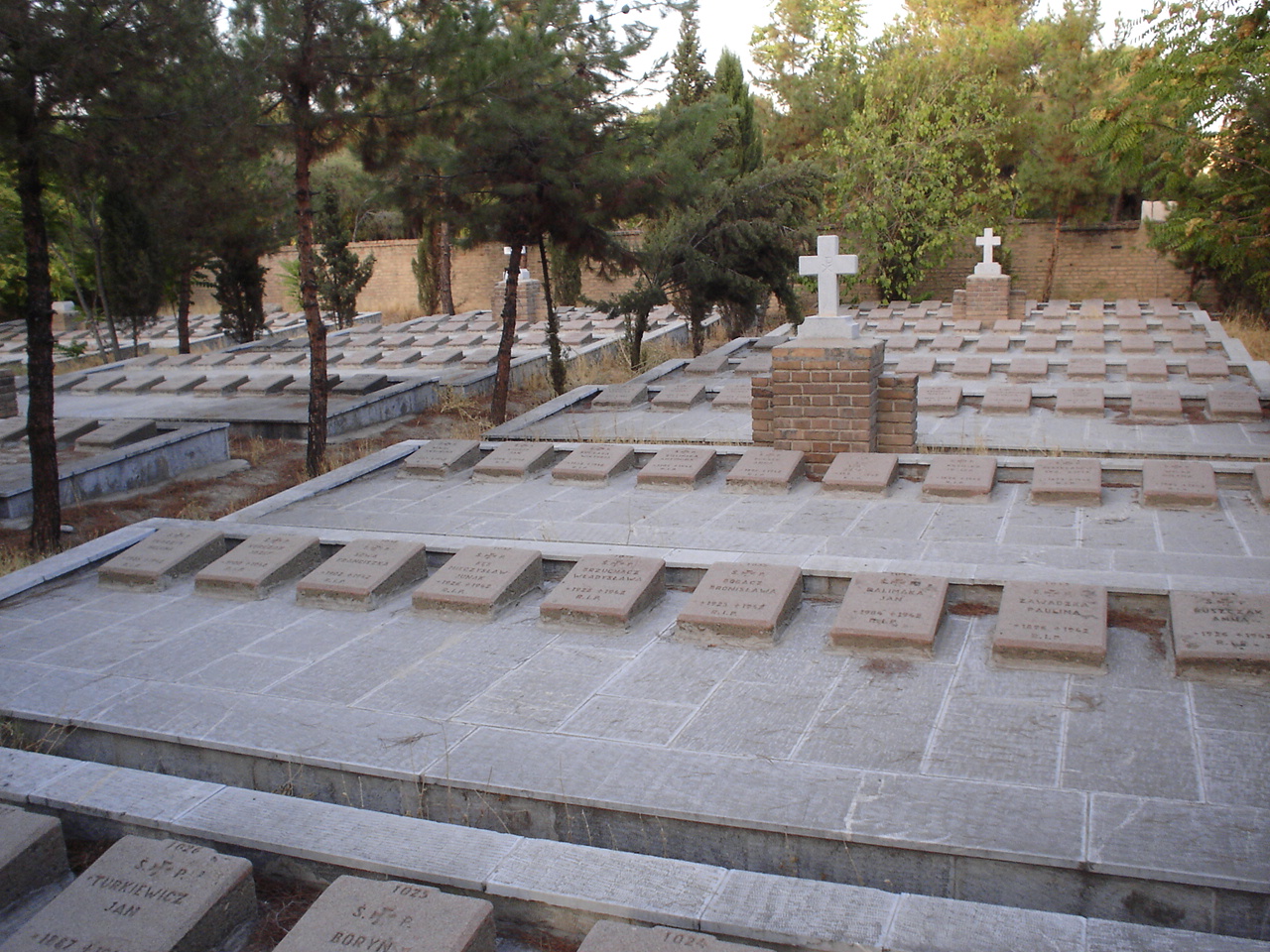
Polish military cemetery, Tehran.
Further reading:
Forgotten Polish Exodus to Persia - Washington Post
The Exile Mission: The Polish Political Diaspora and Polish Americans, 1939-1956. Anna D. Jaroszyńska-Kirchmann. page 26-27 
The Polish Deportees of World War II: Recollections of Removal to the Soviet Union and Dispersal Throughout the World. Tadeusz Piotrowski. page 10-12.

Friday, 30 October 2015

The Ajam of Manama


The Ajam of Bahrain
But first, an introduction. The Ajam (عجم) are an ethnic group in Bahrain composed of ethnic Persians who hold Bahraini citizenship. They have traditionally been merchants living in specific quarters of Manama and Muharraq. They mostly adhere to the Shia sect of Islam. In the Manama Souq, many Persians are clustered in the neighborhoods of Mushbir and Fareeq el-Makharqa. They're estimated to number around 100,000.
The Persian-run school (Ittihad School) in 1939
The story of their origins is actually quite interesting. Let's begin, shall we?

Bahrain was under control of the Persians for a considerable portion of its history (Parthian, Sassanian, Safavid, Qajar dynasties amongst all) so we are going to assume that Persians from across the Gulf migrated at some point to Bahrain. However, we kinda need proof to say this. Proof that we don’t have the luxury of having. In fact, the earliest verified evidence of Persians owning some sort of Bahraini property comes from a deed that indicated the purchase of a date plantation in Bilad al-Qadeem in 1828. 

Why migrate to Bahrain?

Historians agree that large-scale migrations to Bahrain occurred between the 1860s and early 1920s. There are several reasons for this;
  • In the late 19th century, the Shahs, in their infinite wisdom, sought to consolidate revenue from customs and trade along the southern coastline of Iran. Obviously, this impeded merchants on their God-given right to acquire money. Merchants began favouring trading posts across the Gulf (Kuwait, Dubai, Manama) to the extent that they preferred trading in Indian rupees rather than the Persian kran.
  • Southern Iran in the 1860s-1920s wasn’t a fun place. Scarce rain caused food shortages in Bushehr between 1870-72, 1888-92 and 1897-8. Naturally, crime followed and staple food prices like wheat skyrocketed. Locust swarms and outbreaks of cattle disease didn’t help. Famines and outbreaks of diseases like cholera and smallpox in the 1870s and 1890s also certainly didn’t help.
Bonus: Over half of the Ajam are estimated to originate from Dasht district, where Bushehr is the capital city.

When did the Ajam arrive?

Now because the first census of Bahrain was conducted in 1904, we have absolutely no clue on the exact numbers. But we are really good at guesstimating. Records show a sharp increase in the consumption of tea imports, shawl, rosewater, books and shoes in 1873-1905. Persians of the mercantile class were often literate and contemporary writing by British observers welcomed the “more refined taste and superior material culture of the Ajam immigrants” (their words).

What type of people migrated?

If you think all the Ajam were rich traders looking to make a quick buck, you’d be mistaken. The majority of Persians who left Bushehr were economic migrants assisted by relatives in Bahrain or were often simply impoverished peasants and labourers escaping the insecurities of rural Iran. Persians often intermarried with first-cousins and relatives in Iran to promote continuity with their former homeland.

For a case study of the Safar and Sharif families et al, refer to the reference at the end.

The Ajam of Manama

It’s 1904. If you paid attention, you’d know we have the census by now. The census in 1904 showed that over 1,550 Persians lived in Manama, forming the largest permanent foreign ethnic group in the city. Patronage for more Persian immigrants was provided by the Bushehri and Kazerooni families (entrepreneur groups who wished to enlarge their incomes basically) who were responsible for the protection of over 20% of the Ajam population of the city.

The Fareej:

You’d think that with Persians predominately being traders or labourers, they’d be centered around the souq (property-wise at least), right? Nope. The souq’s buildings were owned by members of the ruling family so the Persians improvised by living on the then-outskirts of Manama, resulting in the formation of residential districts we all know and love called the Fareej. 

The oldest of these residential districts are the Fareej Kanoo and Fadhil (collectively known as the fareej-al-Ajam / the Persian quarter) located just east of the souq and port. In the latter half of the 19th century, the Hammam and Makharga districts were established. In the 1920s, the fareej of Mushbir and Bu Sirra were still growing.

The Ajam elite (particularly the Bushehri and Kazerooni families, being building contractors) acquired empty land in the residential quarters to build houses and hut compounds called hawteh. This was how the neighborhoods grew. These residential quarters were often housed by families that knew each other etc.

For the rich Persians, life was good. For the impoverished and unskilled labourer? Not so much. They rarely found accommodation in good places and often worked mainly in the pearl industry or in menial labour alongside the Baharna, freed slaves and Baluchis. In 1929, these poor Persians formed a majority of the labour force in the port; they were often involved in disturbances with the Najdi population (in 1903-4 and 1923). Their populations increased in the 1910s and 1920s. 

For the poor Persian, hawteh was not a luxury they could have. They often lived in concentrated informal housing called barasti or ‘arish. The barasti sprung up in eastern Manama and on marshland of no agricultural value. 

A key way to distinguish rich and poor neighborhoods was by name. Richer neighbourhoods were named after families whereas poorer ones were named after geographic locations (where said-poor Persians came from) like Awadhiyya, Suqaiya and Minawiyyah.
People in front of a barasti, 1930s Bahrain.
Bonus - the history of Adliya
The history of Adliya is somewhat… sad. Actually, it’s very sad.
First founded and named Zulmabad (which literally means the land of oppression), it housed predominately poor Persians from Bander Abbas in 1923. The district was a source of major epidemics and, in an effort by the Manama municipality to clean its act, decided to change its name to an Arabicised Adliya (land of justice!) in 1938. But still, people were poor. It was sad. Such is life.

Author's note: Yes, I am aware of the existence of a wonderful history of the Ajam of Muharraq. I hope to include it at some point in the future. Do add any interesting information in the comments below!

The Deforestation of Nabih Saleh in Bahrain - in Maps!

 This post is an example of the invaluable information and data provided by the groundbreaking people at mapBH . For those unaware, mapBH is...