Tuesday, 25 October 2011

The Great Anglo-American Rivalry in Bahrain


Great power rivalry with Britain for domination of the Gulf was altered significantly by the outcome of World War I. With the defeat of Germany , the dismemberment of the Ottoman Empire and the collapse of Tsarist Russia, Britain emerged in an uncontested position of power and control in the Gulf. At the same time, a new world power was propelled onto the international scene: the United States of America. Although Britain and the USA were allies, it was not long before competition between them began to be registered. In this post, an examination of an Anglo-American rivalry in Bahrain will be discussed from the period following WWI till the dismemberment of the British Raj.

Background Information:
The oil refinery of the Anglo Persian Oil Company (APOC)

There can be little doubt that in 1918, the Gulf had become a British lake. All the states on the Arab side, from Oman to Kuwait, had special treaty relations with Britain that controlled their foreign affairs. Within a short time, Iraq became a British Mandate, and the rich oilfields of Southern Iran were controlled by the British via the Anglo-Persian Oil Company (APOC). Moreover, the Gulf served as a landing and refueling station for trade and supplies from India to Britain.

The United States of America, by contrast, had no territorial or imperial claims in either the Gulf or the rest of the Arab world at this time. Its interests were confined to the activities and establishments of Protestant missionary groups , that have been active since the 19th century.

In the Gulf, the American missionaries of the Dutch Reformed Church provided the only medical services in the region, despite Britain's long tenure of power. Hospitals, under the Church's guidance, were set up in Kuwait, Bahrain, Muscat, Amarah and Basra. They also helped promote education. The American Missionary Hospital is a good example of hospitals established by missionaries.
The American Missionary Hospital, established 100 years ago

Ironic to present-day circumstances, Arabs were largely enthusiastic to the Americans.

Given the broken promises of Britain and France to the Arabs, in addition to the Balfour declaration, many Arabs were supportive of the Americans, emboldened further by President Wilson's Fourteen Points speech.

In fact, in Bahrain, the British Political Agent was annoyed and disturbed whenever Bahraini politicians would remind him of the policy of self-determination!

The Open Door Policy:

The entry of American oil companies in the Gulf was to crystallize the ambiguity of the Anglo-American relationship, and to bring out all the latent feelings of rivalry. The nebulous qualities of American popularity and widespread anti-British feelings in Bahrain now created a tangible situation.

Hitherto, American activity had taken place independently of the US government. The natural isolationism of the latter had never regarded the Arab world as an arena to challenge any of the interests of the European powers.
The 1919 Peace Conference [British Delegation shown]

It was only after the war, when the importance of oil as a strategic weapon was fully recognized, did the US government become directly involved in challenging Britain's hold over oil-producing regions around the world.

The Anglo-American rivalry that was an outcome of this challenge seems to have evolved at a pace that reflected the varying degrees of importance of oil. During the 1919 peace negotiations, the US delegation, secure in the knowledge of American oil reserves, 'did little to promote American oil interests and the British government, attempting to capitalize on that fact, sought to exclude all foreign oil companies from that area [Iraq and Palestine]'.

Consequently, the US pressed on for an Open Door policy on oil so that exclusive British concession would not be granted in British mandated areas of the Middle East. Lord Curzon, British Foreign Secretary, was not in favour of accepting such a policy since the British share of the world oil production was a mere 4.5%  compared to the US' 70%.

Restrictions were put in place for foreign oil companies that, for example, required them to employ British nationals prior to others. The US government objected to the British nationality clause , which it regarded as an obstacle deliberately created to exclude American companies from entering the Gulf.
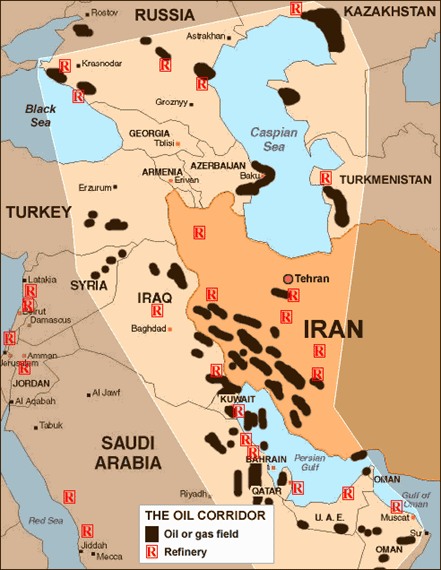
The so-called "Oil Corridor"

Long diplomatic negotiations were initiated but it wasn't until January 1930, that a compromise was achieved. The nationality clause was removed by the Colonial Office, and an oil company, under the umbrella of Standard Oil Company of California (SoCal), was established, termed BAPCO: Bahrain Petroleum Company. It was formed under the conditions that :
  1. that BAPCO would be a British company registered in Canada;
  2. that one of the five directors of BAPCO would be (at all times) a British subject, and his appointment would be made with consultation of the British government.
  3. that BAPCO would always have a Chief Local Representative resident in Bahrain whose channel of communication with the ruler of Bahrain would be through the Political Agent;
  4. that as many employees as possible of BAPCO in Bahrain would be British or Bahraini subjects.
Finally, the Open Door policy was officially sanctioned. Events moved quickly after that and on the 31st of May 1932, oil in commercial quantities was struck in Bahrain. In July 1933, an oil concession deal was struck with the Saudis that would later form the basis of the Arabian American Oil Company (ARAMCO)

John Bull's Face: 1932-1939

In 1938, an article entitled 'Is John Bull's Face Red!' appeared in The American Magazine , it was written in the form of an expose about an 'embarrassing British secret - how Americans beat them to a faraway island of oil [Bahrain]'. A mere article in an ongoing rivalry.

Within a month of the signing of the SoCal deal, the Political Agent in Bahrain expressed his concern that the US government would want to establish a consular office in Bahrain. He was firm in his belief that
It would be most undesirable to have a Consul of the United States of America in Bahrain, as with the Oil interests at his back, he [the would-be American ambassador] would be likely to acquire a powerful position - indeed, he might well tend to supplant the Political Agent!
The BAPCO oil refinery.
The position of the Political Agent in Bahrain was government by the second clause of the 1892 Exclusive Agreement whereby Bahrain undertook not to assent to the residence there of any country or entity but the representative of the British government

As such, he was the only foreign representative and, after the 1919 Order-in-Council, he was empowered to exercise jurisdiction over all foreigners.

Although no population census of Bahrain was taken during the 1930s, it can be assumed that roughly 18% of the population comprised of foreigners. These were Indians, Iranians , Omanis and other Arabs.

There was no Western Community, aside from that serving the British. When BAPCO started operations, the American community started to grow.

In January 1935, there were 24 Americans workers in Bahrain. By 1938, it reached 153 American workers.

World War II and Renewed Tensions:

Once WWII began, the position of the USA began to change, regarding its Gulf policies. Three principal factors governed this change:

The first was the gradual weakening of  Britain's position in the Arab world as a result of the defeats it suffered at the beginning of the war. In 1940, for example, the Mediterranean Sea became closed to British ships; the next year, Germany controlled Yugoslavia and Greece, Rommel's Afrika Korps pushed the British back to El Alamein. In Iraq, the Rashid Ali movement threatened British control over Iraq and its strategic base at Habbaniyya. The possible consequences of the collapse of the British in the Mid-East would have been disastrous to the Americans.

The second factor was an acute financial crisis in Saudi Arabic that set in immediately after the war, due to a massive decrease in Pilgrim traffic and financial mismanagement. It was so severe that in 1940, the King appealed to the British government for money. The US saw itself as not being ready for Saudi Politics but realizing the importance of Saudi oil, sent money to Britain that was to be given to Saudi Arabia.
World War II Scenario. El Alamein is clearly noted.

The third factor was the enter of the US into the war after Pearl Harbour. The Gulf became of great strategic importance for Allied supply lines and air routes. The importance of oil was acknowledged,, particularly in 1943, when the military and naval campaigns in the Far East were growing. By this time, the major US Departments [of War, of Navy, of the Interior, of the State] were actively involved in oil diplomacy.

The old scenario had changed. Roosevelt declared Saudi Arabia to be vital to the defence of America and hence made it eligible for the lend-lease act. For the first time, Britain was perceived as the strong rival for the implementation of the new policy.

Anglo-American rivalry in the Gulf now began in earnest and in two fronts: On the diplomatic level and in the field. It should be noted,however, that both countries were very close allies and relations did not falter. But the British wanted to strengthen their hold on the region, and the Americans wanted to undermine that hold.

Once the tension between the two was recognized, efforts to rationalize the relationship were made. A landmark in the process was the 1944 Anglo-American conversations on the Middle East, held in London. British policy on the Gulf region faced criticism from the Government of India. The reaction from the Viceroy was anger, he was furious at the acknowledgement of American ambitions in the region. He was particularly worried about an American request to build a US consulate in Bahrain, which he saw as unacceptable. Regardless of the criticism, the talks carried on.

In February 1944, an exchange of telegrams between Churchill and Roosevelt illustrated the fears of both sides. Churchill appealed to the US president that there were misgivings in Britain
That the United States has a desire to deprive us of our oil assets in the Middle East on which among other things, the whole supply of the Royal Navy depends on'
Roosevelt explained his side of the problem:
I am disturbed about the rumour that the British wish to horn in on our Saudi Arabian oil reserves.
A compromise was later reached with Churchill stating that :
We are not making Sheep's eyes at your oilfields in Iraq or Iran
The talks opened on the 12th of April 1944, and lasted for two weeks. The discussion covered many countries considered Middle Eastern including: Egypt, Ethiopia, Palestine, Syria, Lebanon, Iraq, Saudi Arabia, Yemen, Oman, Iran and Afghanistan.
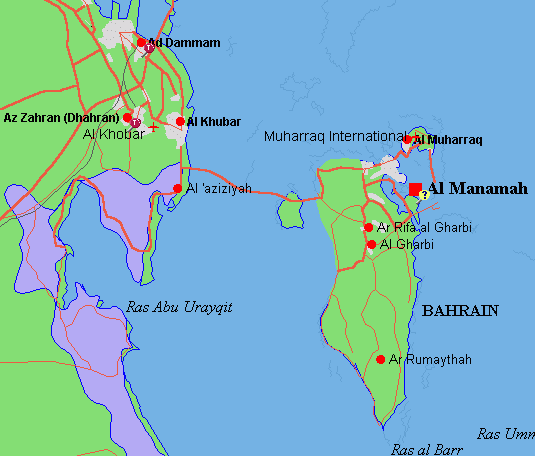
A map of Bahrain and nearby Saudi Arabia

The discussions concerning Bahrain revolved around the wish to establish an American consulate there. Britain refused such an action, citing previous treaty agreements as well as having the fear that this would spark a domino effect on the region. Finally, after much heated negotiations, Britain gave in and a consulate was established in early 1944 and (as predicted) , an American Consulate at Dhahran was opened in September 1944.

[It should be noted that during those times, establishing a consulate was not a simple case, as today, of adding one representative office to another and so on. It was not a routine establishment and it was very complex. It was a sign of influence and strength of a country to establish a  consulate. If one were to be established in Bahrain, it would undermine the British in Bahrain.]

Suspicions of the Americans by the British did not subside. The deployment of 270 soldiers of the US Army Transport Corps to the Consulate, added distrust. America also tried to monopolize the airline system during those times, intending to allow regular flights to and from Bahrain via American civil airlines, this however did not happen.

However, as soon as the war ended, American foreign policy in the region changed once again, this time towards the threat of Communism and of the Soviet Union. Particularly being focused on Russian activity in Iran, particularly after the Tudeh party made statements regarding Bahrain's status. The US now became less interested in Britain's position because of the risk that the Gulf would be an open door to the Russians.

The end of the war also brought with it the realization that Arab oil resources were so large that they could accommodate the interests of both USA and Britain. American policy in the Gulf now had six main thrusts:
  1. To encourage the US missionaries in every way;
  2. To support American commercial interests;
  3. To cooperate with British officials in order to promote US business interests;
  4. to refer to London any outstanding differences between Britain and the USA;
  5. To establish consulates in Muscat and beyond;
  6. To refrain from any measures that would open the region to Russian penetration.
The 3rd and 4th point above indicate the strength of Britain's position. Its main interest in the Gulf had always been strategic, not commercial. The fact that it had been able to withstand Americans resources had been vital to the conduct of the war attests to its ability to maintain the status quo. The political order it had created in the Gulf for over a century remained unchanged despite the dynamics of the changing economic situation. Once again, the Pax Britannica prevailed.

Based on research work done by R.S.Zahlan

Friday, 21 October 2011

Bahrain in the Second World War

Immediately after the United Kingdom had declared war on Nazi Germany, the ruler of Bahrain (Shaikh Hamad) sent the following telegram to the King of Britain.
"...For nearly a century, the Khalifa shaikhs of Bahrain have been on terms of friendship with the British Government...
...Our sympathies in this war which is now being waged against the evil forces of Nazism are with Great Britain. If we possessed an army, we would offer it to the British Government "
In other words, Bahrain was at war.

He also sent a check of £ 30,000 to help the British war effort. Two months later, the Shaikh of Bahrain said that all Muslims should support the Allies, this came at a time when Mussolini styled himself as "the new Caliph Omar". 

The local community started a fund for war charities and in November 1940, a fund was established to buy fighter aircraft for the RAF. By 1943, enough money was raised to buy ten fighter planes,

Bahrain's Defence:

Even though the fighting was restricted to Poland and mainland Europe, Shaikh Khalifa (who was in charge of public security) and Charles Belgrave (British advisor to Bahrain) began discussing defence plans for Bahrain. On the 1st of September 1939, Camel and horse riders were assigned to protect the strategic oil pipelines and refinery. After the demoralizing events of Dunkirk, a special defence force of 150 soldiers was raised to help the war effort. 

After Italy entered the war, rumours of Italian submarines being spotted in the Red sea and beyond became widespread.In September 1940, the crew of an sunken Italian submarine was captured and spent a few days in Bahrain before being deported to a prison camp in the British Raj. 

The following month, Bahrain had its most direct experience of the war. On the night of the 19th of October, 1940 (in an astonishing feat of airmanship), Italian aircraft from the Dodecanese bombed Bahrain via attacking the oil refinery in Awali and also in Dhahran. A total of 84 bombs were dropped but remarkably, no one was injured and no damage was done.

However, this event caused a mass panic amongst the civilian population, now realizing that the war is going to hit home. The British managed to use this attack as an excuse to rally Muslims behind them, stating that the Italian aircraft violated Meccan airspace during its journey.

Interesting fact : Shaikh Mohammed (the ruler's brother), had embarked on a trip to the Mediterranean before hostilities occurred. His Italian ship was due to dock in Beirut but as war was declared, the ship went straight to Italy, bearing Shaikh Mohammed with it. Somehow, he had managed to find his way to Malta, an island that was bombed six times daily. It was not until July 1940 did Shaikh Mohammed finally return home.


The region destabilizes:

In April 1941, Rashid Ali al Gaylani, an anti-British politician, became the Prime Minister of Iraq. Britain couldn't afford to have an Axis sympathizer in the oil heartland of the region and proceeded to invading Iraq and installing a puppet in his place.

When Reza Shah was overthrown in 1941, this caused a backlash against Persians in Bahrain. British troops and officers arrived and plans were discussed to improve the air defences. The overall reaction to Reza Shah's collapse was positive with approveness from a wide variety of people ranging from the upper class to smugglers (who rejoiced the overthrow because Reza Shah had an iron fist on smuggling operations).
The Middle East, in 1930.

The entry of Japan into the war in December 1941 and the subsequent collapse of the British position in South East Asia caused great excitement in Bahrain, particularly as many of its people had colleagues and business associates in Singapore (highlighting the extent of Bahraini trade).

At the same time, the German General Staff worked on one of the most ambitious strategic plans of the entire war. They aimed to launch a great spring offensive to force the Soviet Union to surrender and then to move through Turkey into the Gulf and hence interlink with the Japanese who would've achieved naval superiority in the Indian ocean by then.  

Whether or not the British knew of this plan is not known but they certainly took precautions. On the 16th of April 1942, the British Government announced that :
Bahrain has now come within the zone of operations 
A new RAF station was built in Muharraq, an Air Raid Precautions committee was established, a dug-out was built at the Girls' School, incendiary bomb demonstrations were held and police practiced taking cover during air attacks. In the summer of 1942, reports emerged of unidentified naval destroyers were spotted off the coast of Kuwait and Qatar (likely to have been either the Japanese or confusion).
The RAF insignia for the Muharraq base


A conscription-like campaign was launched and had raised a force of 250 levies based in Muharraq. Many more men were recruited that Belgrave stated that

Muharraq had begun to look like a garrison town
By the spring of 1943, the tide of war had turned. The Germans, after the defeats at Stalingrad and El Alamein , no longer posed a threat to the Middle East.


The Japanese had lost their momentum after being checked by the US Navy. By this time, British soldiers were relocated to other fronts and the levies were disbanded.


Wartime Economy, Rations:

Bahrain was not immune from the rations of WWII. Bahrain had managed to keep the supply of food running since 1939 (25,000 bags of rice were bought from Calcutta alone!) and the shortages started to occur in 1941. An agricultural committee was established to help make more crops but results were not expected. In addition, that winter there was a shortage of vegetables and rice which had previously come in tins from India ; The Indian Government banned the export of anything using tins in order to save metal.
A souq in present-day Bahrain

Rations were officially launched in March 1942, under the vanguard of the Manama Baladiyah (Municipality). Eight centres were opened up to distribute sugar at controlled prices ; each adult received a ticket that entitled him to 4 pounds of sugar a month.

By May, the food situation became satisfactory although there was a severe shortage of bread. This was due to limited imports from India.

To compensate the inevitable increase in food prices, the Bahraini government introduced a War allowance for all those earning less than Rs 150 a month (the average wage was a rupee a day).

With a ration card, an adult was entitled to 12 pounds of rice, 4 pounds of wheat and flour as well as 4 pounds of sugar in a single month.

As a result of Iraq's anti-British sentiments and the Anglo-Iraqi war, imports from Iraq were banned. This was counter-productive as it lead to a shortage of dates. However, a deal between Saudi Arabia and Bahrain allowed 15,000 bags of dates to help solve the shortage problem.Food became scarce and the ration of sugar was cut to 2 pounds, rice to 8 pounds. Once the Anglo-Iraqi war concluded, Bahrain imported a massive 2,000 tonnes of dates within the first month!

In the villages, dates were distributed for free at each of the town squares, and a food centre was established at Souq al Khamis. Even so, signs of malnourishment was reported amongst the elderly and young.
Hyperinflation caused prices to fluctuate, causing prices of Dates (originally 4 rupees) to skyrocket to 30 rupees, the price of tea rose enormously as well, and many butchers (having a lack of imports) closed down.

Other Developments:

We must not have the impression that life in Bahrain revolved around the war, during this time. The death of Shaikh Hamad in February 1942 caused region-wide grief. Government income rose during this period from 3,717,000 rupees (in 1939) to 5,634,000 rupees (in 1946). A smallpox outbreak broke out in 1941, which resulted in a mass-vaccination campaign to be launched. 
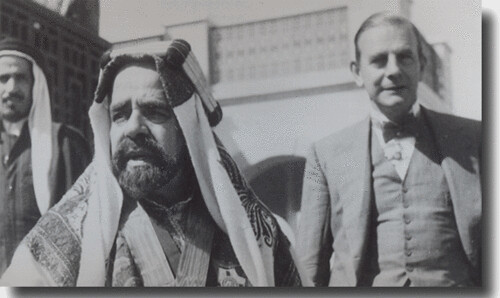
Shaikh Salman Bin Hamad Al-Khalifa (left) and Sir Charles Belgrave 

In 1940, there were 3 girls' schools with 450 students, by 1945, there were 5 girls' schools with 1,139 students. 

The Manama College was opened to give 13-14 year old boys three years' further education in English. Hostel accommodation was introduced for the first time.

In November 1940, Bahrain Radio Station went on the air, and in January 1941 , the first census was held showing a population of just under 90,000. In December 1941, the bridge between mainland Bahrain and Muharraq was opened. In May 1945 Bahrain played their first football match with Saudi Arabia.

After the war, the British Government thanked the Shaikh and his people for their service in the war. Free meals were distributed in Manama, Muharraq and Hidd throughout the month of May, 1945 in celebration. 

Based on the research of Robin Bidwell.

Friday, 7 October 2011

The History of Ice cream

Perhaps one of the most iconic cold snacks of all times, popularized in the 20th century due to the availability of refrigerators. The ice cream has been a sign of a simple way to have a cheap but ever-so-sweet snack during the blistering heat. But the history of ice cream goes back millenniums! In this post, we shall examine and find out who invented (or rather, discovered) the ice cream, when did it go mainstream and stuff.

When Did It First Appear:

Records show that the Persian Empire is credited to have invented the ice cream. According to historians, sometime prior to 400 BC, people would pour concentrated grape juice over snow and eat it whenever the weather used to be hot (apparently, underground chambers were used to storage rooms for this treat).Cities such as Hamedan had seen this occur.

During later periods, modifications and additions were made to the ice cream, such as adding rose water and herbs. By around 200 BC, ice cream appeared in ancient China which was in the form of frozen milk and rice! The Romans soon followed, using snow covered with fruit toppings.

Perhaps the first real mainstream version of ice cream was created by the Arabs in the 10th century, who (for the first time ever) used milk as a main ingredient (heavily sweetened with sugar) instead of the traditional fruit juices.
By this time, it had been widespread throughout the Arab World.

During the 1500s and 1600s, Ice-cream finally appeared in Europe, it was so tasty that legends say that :
Charles I of England was supposedly so impressed by the "frozen snow", that he offered his own ice cream maker a lifetime pension in return for keeping the formula secret, so that ice cream could be a royal prerogative.
Though, it is fair to say that it was largely restricted to aristocrats and the upper class.

Real Ice cream:

Real Ice cream, otherwise known as the ice cream we consume today, was thought to have been invented in 18th England and America. It even appeared in a cookbook [Mrs. Mary Eales's Receipts]:

To ice cream.
Take Tin Ice-Pots, fill them with any Sort of Cream you like, either plain or sweeten’d, or Fruit in it; shut your Pots very close; to six Pots you must allow eighteen or twenty Pound of Ice, breaking the Ice very small; there will be some great Pieces, which lay at the Bottom and Top: You must have a Pail, and lay some Straw at the Bottom; then lay in your Ice, and put in amongst it a Pound of Bay-Salt; set in your Pots of Cream, and 93 lay Ice and Salt between every Pot, that they may not touch; but the Ice must lie round them on every Side; lay a good deal of Ice on the Top, cover the Pail with Straw, set it in a Cellar where no Sun or Light comes, it will be froze in four Hours, but it may stand longer; then take it out just as you use it; hold it in your Hand and it will slip out. When you wou’d freeze any Sort of Fruit, either Cherries, Rasberries, Currants, or Strawberries, fill your Tin-Pots with the Fruit, but as hollow as you can; put to them Lemmonade, made with Spring-Water and Lemmon-Juice sweeten’d; put enough in the Pots to make the Fruit hang together, and put them in Ice as you do Cream.
In 1744, the word Ice-cream appeared in the Oxford English Dictionary.
Ice cream was brought to America via Quaker colonists, and it was thought to have been a favourite treat to the likes of Ben Franklin, George Washington and Thomas Jefferson.

Also, in 1843, Nancy Johnson of Philadelphia was issued the first U.S. patent for a small-scale handcranked ice cream freezer. The Ice-cream cones, sunday and Banana splits became famous around the turn of the century.
Vanilla flavoured ice cream! You know you want it
Though in the UK, it was still expensive to buy ice-cream and hence, Britain relied on imports of snow from Norway and America.

It was only during the second half of the 20th Century did ice-creams become cheap, due to the widespread availability of refrigerators. During this time, companies such as Baskin Robbins were established with mottos like "31 flavors for each day of the month".

An important feature during this time was the invention of 'Soft Ice-Cream'.It was invented in Britain by a chemistry team (of which, future British Prime Minister Margaret Thatcher was a part of). Companies such as Dairy Queen pioneered the age of soft ice-cream.

But today, Ice-cream is widely available and is relatively nothing in price, when compared to previous years. Ice-cream is now available in more than a thousand different flavours , modified with every country and culture it meets and it continues to be one of the most iconic symbols of the human diet.

Monday, 5 September 2011

Lets talk about the Assassins

Immortalized as heroes in games such as the historical fiction Assassin's Creed series, villanized by the media in cases such as the assassination of US President Abraham Lincoln by the infamous John Wilkes Booth. This post isn't about the actual history of assassinations ; there have been many assassinations in history and to list them all would be a pain! Instead , this post will explore a certain group of people who have designated themselves as assassins. In this post, we'll be talking about the Hashashins ( or الحشاشين‎ as its called in Arabic).

The medieval assassins of the Middle East were called Hashashins [some say it means that they used Hashish, a lot while others speculate it has another meaning, namely claiming it means ''foundation' of the faith'']. The assassins had existed in the Middle East for almost 200 years (since 1090 to the 1260s).
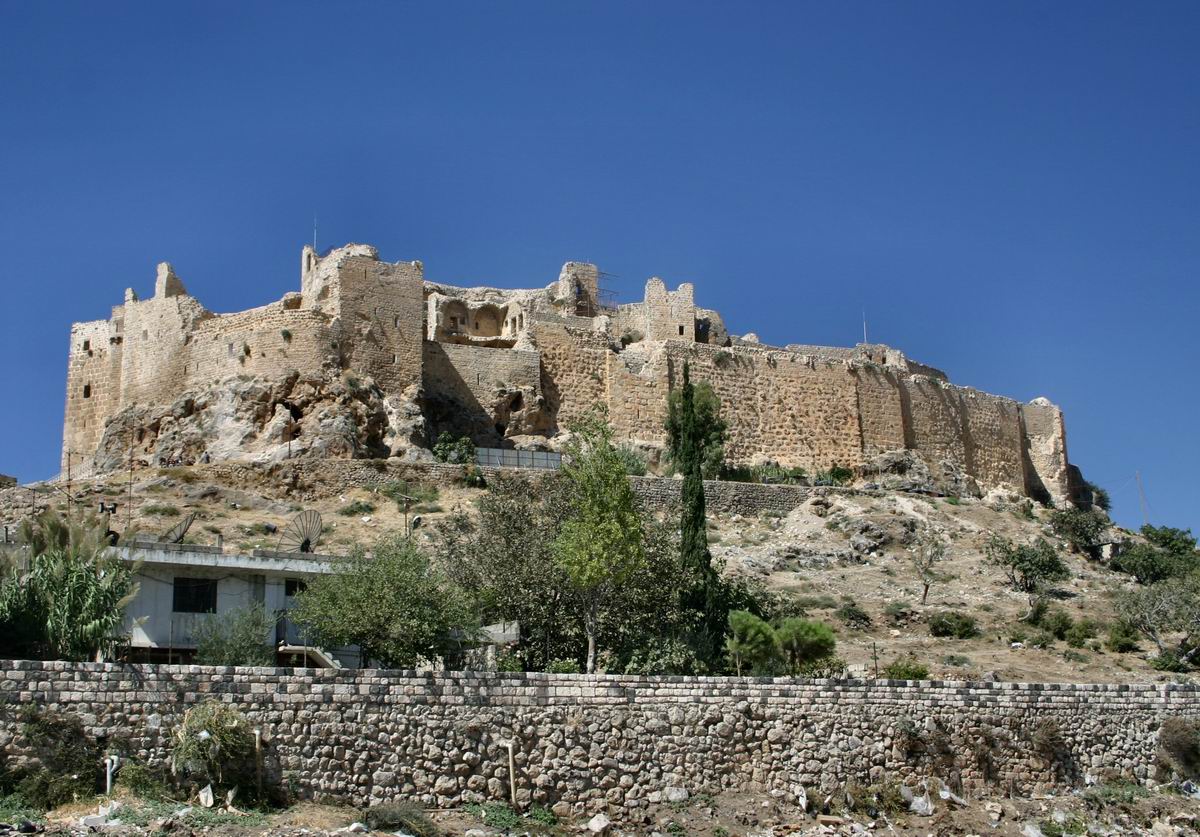
Remains of Masyaf castle.

They mainly lived in the Persian and Syrian mountains, usually in mountain forts and castles.

A famous example (and the one most talked about) is the castle of Masyaf in present-day Syria which served as the base of operations for the Syrian branch of the Assassins.

The assassins were Ismailis (a Shia sect in Islam), as was their founder Hassan Sabbah (c1050-1124AD)

It is not known why he had originally established the Order of the Assassins, but most historians agree it was originally intended to serve his interests to gain political power in the region (at a time of intense competition with not only neighboring Muslim nations but the incoming Crusaders).
The remains of the fortress of Alamut

After creating the Order in 1082 AD, Sabbah designated the mountain fortress of Alamut (1), in the north-west mountainous region of present-day Iran, as his base of operations and proceeded to laying claim and influence to the nearby towns and villages.

Sabbah himself was thought to have never left his fortress ever again since (hence earning the title Old Man of the Mountain), he had devised the order to be created in an hierarchical format. Below Sabbah, the Grand Headmaster of the Order, were those known as “Greater Propagandists”, followed by the normal "Propagandists", the Rafiqs ("Companions"), and the Lasiqs ("Adherents"). It was the Lasiqs who were trained to become some of the most feared assassins, or as they were called, "Fida’i" (self-sacrificing agent), in the known world.(2)
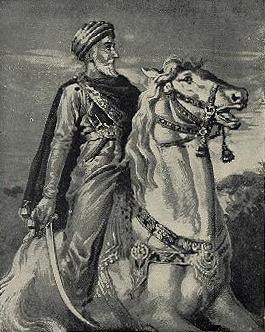
A portrait of Hasan Sabbah

The Fidai were believed to have been the ones who were on Hashish.They were usually young as well, so as to have stamina and greater physical strength.

Soon, Sabbah had ordered his order of Assassins to assassinate prominent politicians and generals of all types and areas.

For an Assassin to get to their targets, the Assassins had to be patient, cold, and calculating. They were generally intelligent and well read because they were required to possess not only knowledge about their enemy, but his or her culture and their native language.
Masyaf territory (in white)

They were trained by their masters to disguise themselves, sneak in to enemy territory and perform the assassinations instead of simply attacking their target outright.

To say that the Assassins fought for the Muslims in the Crusades is not a correct way of defining it.Rather, the Assassins were mercenaries, they assassinated generals and politicians on either side of the Crusaders or the Saracens whenever given a contract to do so.

This ideology, somewhat new to the time, led to the Order of the Hashishins to be labeled a terrorist organization (one of the earliest ever). Indeed, here is a history of the turbulent years lead by Hassan:

  1. 1092: The famous Seljuq vizier Nizam al-Mulk was murdered by an Assassin in Baghdad. He becomes their first victim.
  2. 1094: The Abbasid Caliph Al-Muqtadi dies, and Hassan does not recognize the new caliph, al-Mustazhir. He and his followers transferred their allegiance to his brother Nizar. The followers of Hassan soon even came at odds with the caliph in Baghdad too.
  3. 1113: Following the death of Aleppo's ruler, Ridwan, the Assassins are driven out of the city by the troops of Ibn al-Khashab.
  4. 1110's: The Assassins in Syria change their strategy, and start undercover work and build cells in all cities around the region.
  5. 1123: Ibn al-Khashab is killed by an Assassin.
  6. 1124: Hassan dies in Alamut but the organization still lives. — The leading qadi (Judge) Abu Saad al-Harawi is killed by an Assassin.
But it does not stop there:

1126 November 26: Emir Porsuki of Aleppo and Mosul is killed by an Assassin .

12th century: The Assassins extend their activities into Syria, where they could get much support from the local Shi'i minority as the Seljuq sultanate had captured this territory.
This was how an assassination happens. You STAB!

The Assassins capture a group of castles in the Nusayriyya Mountains (modern Syria). The most important of these castles was the Masyaf, from which the "The Old Man of Mountain", Rashideddin Sinan ruled practically independent from the main leaders of the Assassins.

1173: The Assassins of Syria enter negotiations with Amalric I, King of Jerusalem, with the aim of converting to Christianity.
But as the Assassins by now were numerous and often worked as peasants, they paid high taxes to local Christian landlords, that Christian peasants were exempted from. Their conversion was opposed by the landlords, and this year the Assassin negotiators were murdered by Christian knights. After this, there was no more talk of conversion.

1175: Rashideddin's men make two attempts on the life of Saladin, the leader of the Ayyubids. The second time, the Assassin came so close that wounds were inflicted upon Saladin.

1192: Conrad of Montferrat, King of Jerusalem, is stabbed to death by Assassins before his coronation.

1256: Alamut fortress falls to the Mongols under the leadership of Hülegü. Before this happened, several other fortresses had been captured, and finally Alamut was weak and with little support.

1257: The Mongol warlord Hülegü attacks and destroys the fortress at Alamut. The Assassin library is fully razed, hence destroying a crucial source of information about the Assassins.

Around 1265: The Assassin strongholds in Syria fall to the Mamluk sultan Baybars.

Ultimately, the Order of the Assassins was finally crushed and destroyed during the horrific Mongol Invasion of Khwarizm.

They were specifically targeted by the Mongols after a failed assassination attempt on the Möngke Khan, where Mongol records say hundreds of assassins had attacked his palace.
A portrait of Möngke Khan

Because of that act, the Order of the Assassins was wiped out in the following months by 1256 AD.
(Indeed, decrees existed that "called for the eradication of the Ismailis" by Shams ad Din, the chief judge of Qasvin).

Alamut was captured in December, 1256 and the last grandmaster of the Assassins,  Grand Master Imam Rukn al-Din Khurshah, was executed.

The Syrian branch continued to operate but under Mamluk supervision.

But for all it matters, the Order of the Assassins was finally crushed.


 References and Further Reading:


(1)- Daftary, Farhad. The Ismailis: their history and doctrines (Cambridge: Cambridge University Press, 1990),

(2) - Nowell, Charles E. (1947). "The Old Man of the Mountain".
(3) - The Secret Order of Assassins 

Saturday, 20 August 2011

Black Death caused by Rats ? Not Exactly..

More Archaeology news this week!
A fairly remarkable and interesting read this week was the Guardian revealing a study that shows that rats were not the main carriers of the dreaded Black Death (believed to have been the Bubonic Plague), but in fact, it was their human counterparts!

From the Guardian:

Black Death study lets rats off the hook

Plague of 1348-49 spread so fast in London the carriers had to be humans not black rats, says archaeologist
    Black death victims at Old Royal Mint, London
    Bubonic plague victims of 14th century London, uncovered in the 1980s in an excavation at the Old Royal Mint. Photograph: Rex Features
    Rats weren't the carriers of the plague after all. A study by an archaeologist looking at the ravages of the Black Death in London, in late 1348 and 1349, has exonerated the most famous animal villains in history.
    "The evidence just isn't there to support it," said Barney Sloane, author of The Black Death in London. "We ought to be finding great heaps of dead rats in all the waterfront sites but they just aren't there. And all the evidence I've looked at suggests the plague spread too fast for the traditional explanation of transmission by rats and fleas. It has to be person to person – there just isn't time for the rats to be spreading it."

    He added: "It was certainly the Black Death but it is by no means certain what that disease was, whether in fact it was bubonic plague."

    Sloane, who was previously a field archaeologist with the Museum of London, working on many medieval sites, is now attached to English Heritage. He has concluded that the spread of the 1348-49 plague, the worst to hit the capital, was far faster, with an impact far worse than had been estimated previously.
    While some suggest that half the city's population of 60,000 died, he believes it could have been as high as two-thirds. Years later, in 1357, merchants were trying to get their tax bill cut on the grounds that a third of all property in the city was lying empty. Sloane spent nearly 10 years researching his book, poring over records and excavation reports. Many records have gone missing, while there was also a documentation shortfall as disaster overwhelmed the city. Names of those buried in three emergency cemeteries seem not to have been recorded.
    However, Sloane found a valuable resource in records from the Court of Hustings, of wills made and then enacted during the plague years. As the disease gripped – in October 1348 rather than the late summer others suggested, reaching its height in April 1349 – the numbers of wills soared as panic-striken wealthy citizens realised their deaths were probably imminent.
    On 5 February 1349 Johanna Ely, her husband already dead, arranged provision for her children, Richard and Johanna. She left them property, spelled out which beds and even pots and pans each was to receive, and placed them in the guardianship of her own mother. She was dead within 72 hours.
    It appeared to the citizens that everyone in the world might die. Richard de Shordych left goods and money to his son Benedict when he died in early March: his son outlived him by a fortnight.
    Money, youth, and formerly robust good health were no protection. Edward III's own daughter, Joan, sailed for Spain with her trousseau, her dowry and her bridesmaids, to marry Pedro, heir to the throne of Castile. She would never see her wedding day as she died of the plague within 10 days of landing.
    John of Reading, a monk in Westminster, left one of the few witness accounts. He described deaths happening so fast there was "death without sorrow, marriage without affection, self-imposed penance, want without poverty, and flight without escape".
    In Rochester, William of Dene wrote that nobody could be found to bury the dead, "but men and women carried the bodies of their own little ones to church on their shoulders and threw them into mass graves from which arose such a stink that it was barely possible for anyone to go past a churchyard".
    Sloane estimates that people living near the cemetery at Aldersgate, which is now buried under Charterhouse Square, in Smithfield, would have seen a corpse carried past every five minutes at the height of the plague.
    As many wills were being made in a week as in a normal year. Usually these would only be activated months or years later: in the worst weeks of the plague there was barely time to get them written down. Many, like Johanna Ely, probably made their wills when they felt the first dreaded sweats and cramps of the disease. Others left property and the care of their children to people who then barely outlived them.
    The archaeology of the plague also reveals that most people, however, were buried with touching care, neatly laid out in rows, heads facing west, with far more bodies put in coffins than in most medieval cemeteries – but possibly through fear of infection.
    Only a few jumbled skeletons hint at burials carried out some time after death and decomposition; those cases probably arose because bodies were found later on in buildings where every member of the household had died.
    Sloane believes there was little difference in mortality rates between rich and poor, because they lived so closely packed together. The plague, he is convinced, spread from person to person in the crowded city. Mortality continued to rise throughout the bitterly cold winter, when fleas could not have survived, and there is no evidence of enough rats. Black rat skeletons have been found at 14th-century sites, but not in high enough numbers to make them the plague carriers, he said.
    In sites beside the Thames, where most of the city's rubbish was dumped and rats should have swarmed, and where the sodden ground preserves organic remains excellently, few black rats have been found.
    Sloane wants to dig up Charterhouse, where he believes 20,000 bodies lie under the ancient alms houses and modern buildings, including the Art Deco block where the fictional character Hercule Poirot lives in the television series. And, if anyone finds a mass medieval rat grave, he would very much like to know.
 This seems to be going against what was traditionally taught in school, someone ought to tell them the current history lessons are (even for History lessons) obsolete and too old.

This is yet another example of (to copy the phrase) lies my History teacher told me.

Wednesday, 17 August 2011

A Short History of Aleppo - From Pre-History till the Medieval Era

Aleppo has been in the headlines recently, for a lot of reasons. I shall not delve into that but merely would like to remind people about its rich history and culture. To simply forget about one of the oldest continually inhabited cities in the world would be an insult to its legacy. This post aims to summarize and give the reader a historical knowledge of Aleppo.

Geography and Pre-Islamic History:


A map showing Aleppo (I don't own the map!)
First of all, it is important that we grasp in our mind the exact location of Aleppo so that we may refer to it , later in this post. Aleppo is located in northern Syria, not too far from the Turkish border (about 45 kilomtetres). Aleppo is also an inland city. 

Now that the geography bit is covered, we shall delve into the actual history. As mentioned before, Aleppo is one of the world's oldest continually inhabited cities. 

This is because archaeologists and historians believe that the site of the present city covers the ancient city of Aleppo which was inhabited since 5000 BC.
Aleppo had a bright early history by being the seat of power (the Capital) of an Akkadian kingdom somewhere around the third Millennium BC. Aleppo's name also first appears in old Babylonian records, where it was called Halab.

And as before, it was the capital of another dynasty (the Yamhad dynasty) during its reign of 1800 to 1600 BC, it was believed to have been one of the powerful states in the Near East at the time. The Yamhad dynasty was destroyed by the invading Hittites in the 16th Century BC. During the later centuries, the Egyptians and Hittites battled in the wars of the Levant and Aleppo found itself at the frontline.

By around the 9th Century BC, Aleppo fell to the Neo-Assyrians, and then to the Neo-Bablyonians and finally laid into the hands of the Achaemenid Persian Empire in the 7th Century BC.


As part of his conquest, Alexander II of Macedon (popularly known as Alexander the Great) conquered Aleppo in 333 BC and a new city called Beroea (Βέροια) was built on its site. Aleppo later became a cultural stronghold of Greek Hellenism for centuries to come and was later part of the Seleucid Empire after Alexander's death where it remained so for almost 300 years until Pompeii the Great conquered the city in 66 BC.
The Romans built bridges, like this , in Aleppo

The Roman era saw an increase in the population of northern Syria that accelerated under the Byzantines well into the 5th century. In the Late Antiquity era,  Beroea was the second largest Syrian city after Antioch,  the capital of Syria and the third largest city in the Roman world.

Archaeological evidence indicates a high population density for settlements between Antioch and Beroea right up to the 6th century CE. This agrarian landscape holds now the remains of large estate houses and churches such as the Church of Saint Simeon Stylites.

Saint Maron of the Maronite Church was probably born in this region; his tomb is located at Brad to the west of Aleppo.

Islamic Conquest, The Crusades and the Medieval Era:

The Sassanian Persian Empire briefly took hold of Aleppo from the Byzantines in the early 7th Century AD. At this time however, the Arabs burst out of the Arabian Peninsula and by 637 AD, Aleppo was conquered by the Arabs under the leadership of Khalid Bin Waleed. The city had been relatively prosperous for the following centuries, even being the capital of an independent emirate in the 900s as well as producing fine poets like Al Farabi. 

However, a resurgent Byzantine Empire would later sack Aleppo in 962 AD and occupy it for more than 10 years ( 974-987 AD). During the Crusades, the city was besieged twice by the Crusaders in 1098 and in 1124, but was not conquered.

Perhaps a date infamously known in History was the 9th of August, 1138 : A massive earthquake struck through Aleppo and had completely ravaged the city and the countryside. Records at the time say 230,000 people had died in the earthquake, effectively making it the third deadliest earthquake of all times. Aleppo was never to recover fully from the earthquake.

During the Third Crusade, the city fell under the control of Saladin (Salah-ad Din, the famous Kurdish warrior) and his Ayyubid dynasty. In January of the year 1260 AD, the Mongols struck Aleppo with an alliance of Armenians and Frankish knights. The city fell in under 6 days and the Muslim and Jewish population were massacred. The Christian population was spared. The Mongols handed control of the territory to the Frankish knights.
The mighty Citadel of Aleppo

However, in September 1260 AD, the Egyptian Mamluks negotiated for a treaty with the Franks of Acre which allowed them to pass through Crusader territory freely, and engaged the Mongols at the Battle of Ain Jalut on September 3, 1260.

The Mamluks won a decisive victory, killing the Mongols' Nestorian Christian general Kitbuqa, and five days later they had re-taken Damascus. Aleppo was recovered by the Muslims within a month, and a Mamluk governor placed to govern the city. Hulagu sent troops to try to recover Aleppo in December. They were able to massacre a large number of Muslims in retaliation for the death of Kitbuqa, but after a fortnight could make no other progress and had to retreat.

The Mamluk governor of the city became insubordinate to the central Mamluk authority in Cairo, and in Autumn 1261 the Mamluk leader Baibars sent an army to reclaim the city.

In October 1271, the Mongols took the city again, attacking with 10,000 horsemen from Anatolia, and defeating the Turcoman troops who were defending Aleppo. The Mamluk garrisons fled to Hama, until Baibars came north again with his main army, and the Mongols retreated.

On 20 October 1280, the Mongols took the city again, pillaging the markets and burning the mosques. The Muslim inhabitants fled for Damascus, where the Mamluk leader Qalawun assembled his forces. When his army advanced, the Mongols again retreated, back across the Euphrates.
A portrait of Tamerlane, a cruel and brutal ruler

Aleppo returned to native control only in 1317. In 1400, the Mongol-Turkic leader Tamerlane captured the city again from the Mamluks.

He massacred many of the inhabitants, ordering the building of a tower of 20,000 skulls outside the city. After the withdrawal of the Mongols, all the Muslim population returned to Aleppo.

On the other hand, Christians who left the city during the Mongol invasion were unable to resettle back in their own quarter in the old town, a fact that led them to establish a new neighborhood in 1420, built outside the city walls, at the northern suburbs of Aleppo.

This new quarter was called al-Jdeydeh ("the new district" in Arabic).


 That concludes this post. I hope you enjoyed it :)

 Sources:

1. Battle of Aleppo - War with the Mamluks
2.English Historical Review

For Further Reading:

1.Constructions of Power and Piety in Medieval Aleppo

2.Muslim Fortresses in the Levant: Between Crusaders and Mongols (Culture and Civilization in the Middle East)
3. The New Cambridge Medieval History: Volume 4, c.1024-c.1198, Part 2

Thursday, 11 August 2011

Marco Polo never reached China ?

Recently, archaeologists have claimed that Marco Polo, the famous Venetian traveler who was said to have traveled from Europe to Persia, Central Asia and China, may have been a fraud !

As said in the Sydney Morning Herald:

HIS journeys across mountain ranges and deserts opened the eyes of mediaeval Europe to the exotic wonders of China and the Silk Road, establishing him as one of history's greatest explorers.
But a team of archaeologists believe Marco Polo never even reached the Middle Kingdom, much less introduced pasta to Italy after bringing it back from his travels, as legend has it.
Instead they think it more likely that the Venetian merchant adventurer picked up second-hand stories of China, Japan and the Mongol Empire from Persian merchants he met on the shores of the Black Sea, thousands of kilometres short of the Orient.
He then cobbled them together with other scraps of information for what became a best-selling account, A Description of the World, one of the first travel books.

The archaeologists point in particular to inconsistencies and inaccuracies in his description of Kublai Khan's attempted invasions of Japan in 1274 and 1281. ''He confuses the two, mixing up details about the first expedition with those of the second. In his account of the first invasion, he describes the fleet leaving Korea and being hit by a typhoon before it reached the Japanese coast,'' said Daniele Petrella of the University of Naples, the leader of an Italian archaeological project in Japan. ''But that happened in 1281 - is it really possible that a supposed eyewitness could confuse events which were seven years apart?''
Marco Polo's description of the Mongol fleet is sharply at odds with the remains of ships that the team have excavated in Japan. The Venetian wrote of five-masted ships, when they had only three masts, said Professor Petrella.
''It was during our dig that doubts began to emerge about much of what he wrote,'' he told the latest edition of Focus Storia, an Italian history magazine.
''When he describes Kublai Khan's fleet he talks about the pitch that was used to make ships' hulls watertight. He used the word chunam, which in Chinese and Mongol means nothing. In fact it is the Persian word for pitch. It's also odd that instead of using, as he does in most instances, local names to describe places, he used Persian terms for Mongol and Chinese place names.''
The explorer claimed to have worked as an emissary to the court of Kublai Khan, but his name does not crop up in any of the surviving Mongol or Chinese records.
The Italian archaeologists' scepticism over the extent of Marco Polo's travels adds weight to a theory put forward by a British academic. In a book published in 1995, Did Marco Polo Go to China?, Frances Wood, the head of the Chinese section at the British Library, argued that he probably did not make it beyond the Black Sea.
She pointed out that despite being an acute observer of daily life and rituals, there is no mention in Marco Polo's chapters on China of the custom of binding women's feet, chopsticks, tea drinking, or even the Great Wall.
''There's nothing in the Venetian archives to say that the Polo family had direct contact with China at all,'' Dr Wood said yesterday. ''Nothing from China has ever been found in the possessions they left behind.
''One theory is that Marco Polo copied a sort of guide book on China written by a Persian merchant. Only about 18 sentences in the entire manuscript are written in the first person.''
If proven to be true, this is a complete turn-around from what we've been taught in school. And we can simply say that [if true], Marco Polo may have been one of the greatest conman to ever scam the world!

This would , at least how I view it, an embarrassment to Europe (and to Venice too) to realize that one of their greatest explorers was a fraud.


The Deforestation of Nabih Saleh in Bahrain - in Maps!

 This post is an example of the invaluable information and data provided by the groundbreaking people at mapBH . For those unaware, mapBH is...