Monday, 12 December 2011

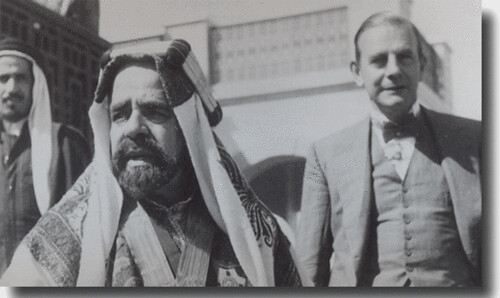
A photo from yesteryear: The first Muharraq-Manama bridge

Translates to "A picture of the Shaikh Hamad bridge in the 1950s"
For Bahrainis nowadays, the idea that mainland Bahrain and the island of Muharraq were not connected with any roads, seems like a pretty unbelievable thing.
An old map of Bahrain, not showing current bridges


But for almost all of Bahrain's history, this was the case. No roads whatsoever.

If you wanted to go to Muharraq, you would have to get a boat ride (or if you're strong enough, you could swim!).

Then, in the 20th century, history was made. Muharraq and Manama, reconnected for the first time since the formation of the Bahrain islands!

Though, the bridge built was no highway. As you could see from the photo above, it was a single lane bridge, and had a relatively simple complex when compared to modern bridges.

Nonetheless, I blog this because I found this picture to have been a reminder about how Bahrain has progressed throughout the ages. How much Bahrain has modernized and grown. Shopping Malls come and go, so do sports events and stuff like that. But history remains forever.

Friday, 9 December 2011

Freshen Up With Archaeology Friday (Post I)

Every Friday, I shall be posting the latest news from the field of archaeology and hopefully, I won't miss a single Friday! So, lets start off with this week:
Ancient Stone Markings in Jerusalem stuns Experts:

The marks are believed to be 2,800 years old

On the seventh of December, 2011, Archaeologists discovered what seemed to have been a rather odd find in an excavation in Jerusalem.
The archaeologists uncovered a complex of rooms carved into the bedrock in the oldest section of the city recently found the markings: 
Three "V" shapes cut next to each other into the limestone floor of one of the rooms, about 2 inches (5 centimeters) deep and 20 inches (50 centimeters) long.
There were no finds to offer any clues pointing to the identity of who made them or what purpose they served.
he shapes were found in a dig known as the City of David, a politically sensitive excavation conducted by Israeli government archaeologists and funded by a nationalist Jewish group under the Palestinian neighborhood of Silwan in east Jerusalem. The rooms were unearthed as part of the excavation of fortifications around the ancient city's only natural water source, the Gihon spring.
It is possible, the dig's archaeologists say, that when the markings were made at least 2,800 years ago the shapes might have accommodated some kind of wooden structure that stood inside them, or they might have served some other purpose on their own. They might have had a ritual function or one that was entirely mundane. 
Archaeologists faced by a curious artifact can usually at least venture a guess about its nature, but in this case no one, including outside experts consulted by Shukron and the dig's co-director, archaeologists with decades of experience between them, has any idea.
There appears to be at least one other ancient marking of the same type at the site. A century-old map of an expedition led by the British explorer Montague Parker, who searched for the lost treasures of the Jewish Temple in Jerusalem between 1909 and 1911, includes the shape of a "V" drawn in an underground channel not far away. Modern archaeologists haven't excavated that area yet.
Ceramic shards found in the rooms indicate they were last used around 800 B.C., with Jerusalem under the rule of Judean kings, the dig's archaeologists say. At around that time, the rooms appear to have been filled with rubble to support the construction of a defensive wall.
It is unclear, however, whether they were built in the time of those kings or centuries earlier by the Canaanite residents who predated them.

Centuries-Old Witches' Cottage and Mummified Cat Unearthed in Britain

The ruined cottage where the mummified cat was found


A cottage believed to be linked to a famous group of 17th-century English witches and a mummified cat were unearthed by workmen in Lancashire, northern England.

The site, described by one archaeologist as "Lancashire's Pompeii," was discovered during a construction project, Sky News reported.

Water engineers found the 17th-century cottage during excavations in Pendle, and experts think it could be connected to the famous Pendle Witches, a group of 16 women tried for witchcraft in 1612.

It is thought the mummified cat -- found sealed into one of the walls -- may have been entombed in the wall while still alive, as paranormal protection.

"Cats feature prominently in folklore about witches. Whoever consigned this cat to such a horrible fate was clearly seeking protection from evil spirits," Pendle Witches expert Simon Entwistle said. "We're just a few months away from the 400th anniversary of the Pendle Witch trials, and here we have an incredibly rare find, which could well be the famous Malkin Tower."

Malkin Tower was said to be the site of a notorious meeting between the witches on Good Friday in 1612.
Frank Giecco, who led the team that unearthed the cottage, said, "It's like discovering your own little Pompeii. We rarely get the opportunity to work with something so well preserved. As soon as we started digging, we found the tops of doors and knew we were onto something special."

The cottage is said to be in remarkable condition and contained many 19th-century artifacts such as crockery, a cooking range and a bedstead. The construction project was put on hold while archaeologists investigate the site.

Wednesday, 30 November 2011

Bahrain's History through a Digital Lens

It is of no surprise to people that the internet has changed the way we view things. Changed the way we look at things. But more importantly, it is now a place where the past is stored.

Lets face it, with Google News archive program (and more recently, with the launch of the British Newspaper Archive), the past is now being even more immortalized. Cyber space is the new dimension, it seems.

But a focus of this article I'd like to bring up is digitalizing Bahrain's modern history. Thanks to Google News archives, we can now see articles over 40 (and sometimes 70!) years old, about Bahrain's progressing history. I take an emphasis on Bahrain because it is my home country (But be sure to play around with it, with your own name!).

In this article, we shall look back at some of Bahrain's history in the 20th century. Some forgotten and some immortalized.

1. 542 Escape From Blazing Ship off Bahrain

April 8th 1961 - A British Passenger liner caught fire (an explosion was thought to have caused it) and British naval frigates were deployed to the scene. 542 people were rescued including 119 crew, and 440 passengers, most of them Indians, Pakistanis and some Britons and Americans.

The ship was en route to Bombay (now Mumbai) from the Iraqi port of Basra.

2. 28 Dead on US Frigate hit by Iraqi missile


Perhaps a day of infamy for Americans all over again. In May 17, 1987, the USS Stark (FFG-31) was struck by two Exocet missiles fired from an Iraqi Mirage F1 fighter plane.

This was the first time since the 60s,, where a US naval ship was successfully targeted and fatalities occurred. This happened a few kilometres off Bahrain's coast. 

What was strange was that the frigate did not respond or fire back to the attack. This has been the centre of an ongoing controversy. Still, even nowadays, what happened to the ship is disputed. But whatever happened, it left 37 sailors dead and 21 injured. 

If you'd like to know more, the Wikipedia page provides good information. 


3. 92 on German Plane Hijacked to Bahrain:


Would you believe it! A hijacking and the landing spot ? Bahrain! 


On October 14th, 1977: Gunmen, demanding the "release of all comrades in West German prisons" , hijacked a Lufthansa airliner with 92 passengers on it.

The plane, Lufthansa Flight 181, having refueled in Rome and Cyprus was now to venture to Bahrain. The hijacking was believed to be related to the kidnapping of the prominent West German industrialist, Hanns Martin Schleyer


Lufthansa had said that the plane was filled with mostly West Germans returning from vacation in Mallorca. 11 Beauty queens are also believed to have been on board.

The plane would later travel to Dubai and onwards to Mogadishu where the plane's captain is killed. German special forces soon storm the plane at the airport. 3 Terrorists were killed, the hostages were secured. In retaliation, Hanns Martin was executed. 

4. Bahrain declares independence, cuts ties with Britain


August 14, 1971 - A new country was born! The nation of Bahrain, with a population of 200,000 people, joined the ranks of the United Nations and the Arab League soon after. 

After having trade ties and treaties with the United Kingdom of Great Britain and Northern Ireland since the 19th century, Bahrain cut all ties with the British*

*(It was a rite of passage to cut all agreements made before independence, with the colonial power).

Bahrain decided to go it alone and not join the federation of the Trucial States (Present day United Arab Emirates), and "wanted to form a close relationship" with the much richer and influential state of Kuwait.

Wednesday, 9 November 2011

Who were the Hittites?

Just over a hundred years ago, the name 'Hittite' was almost unknown, apart from one or two references in the Bible. Then, in 1880, an Englishman named Sayce said that a number of rock carvings in modern Turkey ( in central Turkey, to be precise), resembled remains of a long forgotten empire - that of the Hittites

. He was proved to be correct when, in 1906, a large number of clay tablets were unearthed at a place called Boghazkoy (in central Turkey).
The entrance to Hattusa, the symbolic "Lion's gate"

The tablets were mostly in the wedge-shaped signs of Mesopotamia and some could be read without too much difficulty. Others, although looking like straightforward cuneiform, turned out to be in an unknown language.

There were also inscriptions in a kind of picture writing. It took many years before it became possible to decipher the picture writing.

The decipherers were helped when some stone pillars with messages carved on them were found at Kaaratepe. There were two languages; Hittite and Phoenician, the latter is already known.

The columns were to the Hittites what the Rosetta stone was to the Egyptians, it gave the decoders new symbols and their meanings. Some suspect that the Hittite language might have belonged to the same group of languages as the ancestors of most modern European ones (including English!). Now, scholars could make out "WADAR" and "EZZATENI" translate into "WATER" and "EAT".

They also found out that the place where the first tablets were found was in fact called Hattusas at about 1600 B.C. and was the capital of the ancient empire of the Hittites.

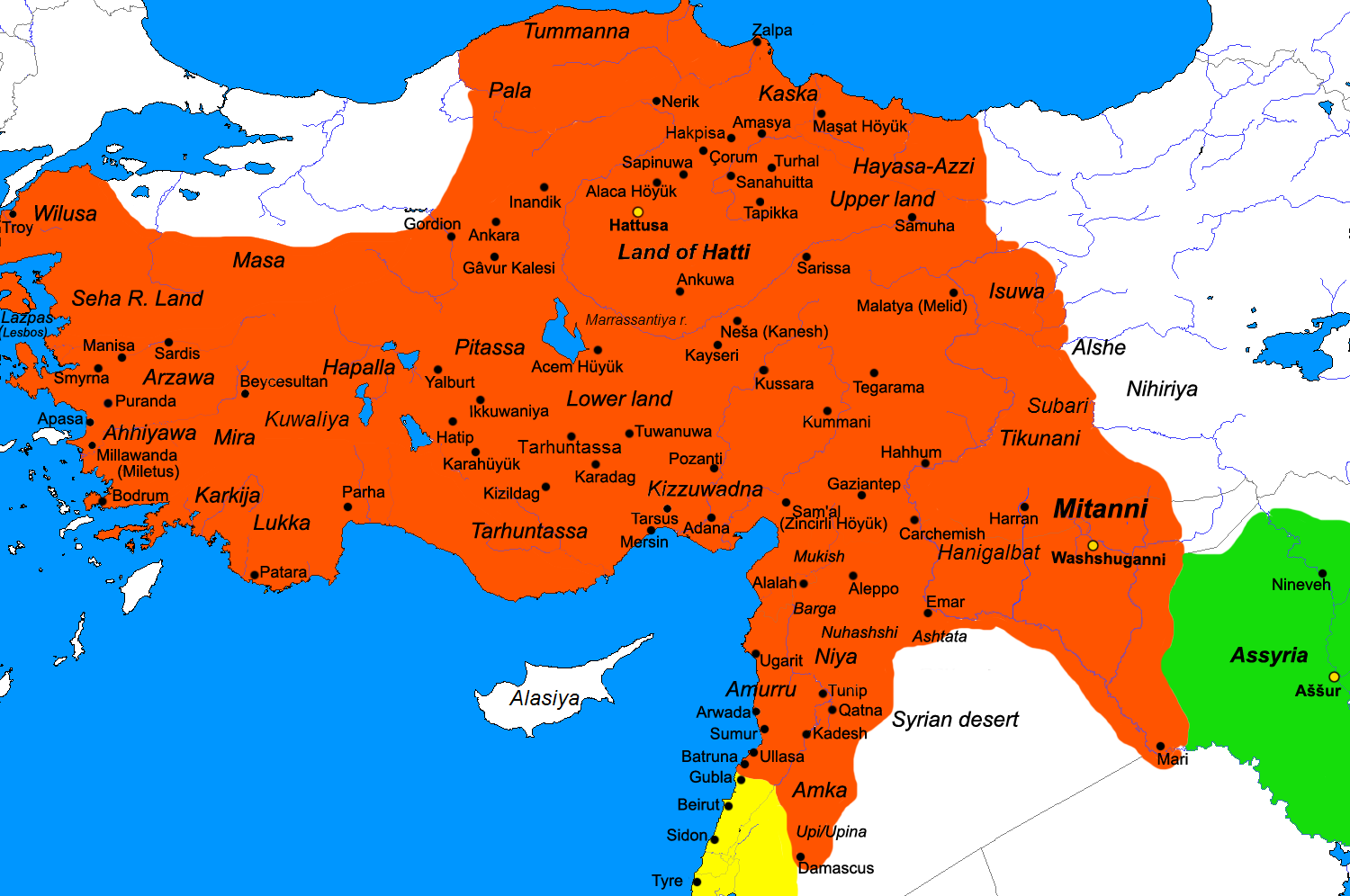
Hattusas had a fortified citadel and massive surrounding walls over two miles long. The Hitties claimed that it was one of the cities taken by their legendary kings, Pithanas , and his son, Anittas. A few other conquered towns can be identified - enough to show that at its greatest extent, the whole of Anatolia, Suria, Turkey, much of present day Palestine, Cyprus and northern Iraq were under Hittite control.
The Hittite empire at its greatest extent (Hattusa marked with yellow)

One Hittite king made a surprise attack down the Euphrates in 1595 B.C. and captured Babylon.

Another, Suppiluliumash, was such a great conqueror that the widow of Tutankhamen (the legendary King Tut) wrote him an official letter asking that one of his sons to marry her.

Ordinary Hittites were of medium height, thickset and with bony noses.
They wore felt boots and short belted kilts. Some were bearded and others clean shaven. They grew barley, wheat and also raised sheep & goats.

Like most ancient people at the time, they were Pagans and worshiped numerous Gods, the chief of which was called Teshup (the equivalent of Thor).

One of the secrets of Hittite military success was their use of iron for weapons. Before 1400 B.C., it was known that some red minerals would reduce to metal at temperature not much about those for producing molten copper from blue and green ores. But iron will only flow like copper or lead in much hotter fires, a process which was not to be invented for another 3,000 years.

The Hittite method was repeated beatings and hammerings to drive out the rock impurities. If you were very lucky, and had a little carbon in your iron ore, you'd make a great sword with it. The knowledge of how to do this wasn't available to the rest of the world until the collapse of the empire in about 1200 B.C.
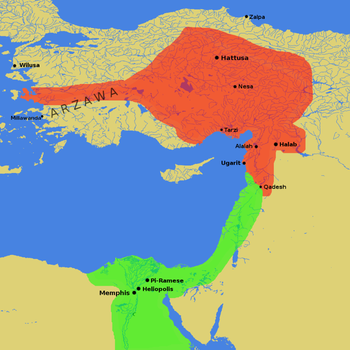
The Hittite and Egyptian Empire, Kadesh (Qadesh) is marked

Just before this happened, Muwatallis, the Hittite king, claimed a great battle victory against the Egyptians in the battle of Kadesh (which was the first ever recorded battle in history, in terms of details of soldiers and formation).

Rameses II, the Egyptian Pharaoh, also claimed to have won the battle, as his numerous monuments bear witness to.

The battle was probably a draw. It was the last great engagement of the Hittite army with its light, spokewheeled and horse-drawn chariots.

Great movements of peoples in the Middle East only a lifetime later, led to the disappearance of the Hittite empire.

Some of the old provincial city states survived for a few more centuries, for example Carchemish, Malatya and Karatepe. It was probably one of these shadowy 'Neo-Hittite' kingdoms that were referred in the Bible.
The Battle of Kadesh was the earliest recorded battle in history where formations were recorded

500 years after the destruction of the capital, Hatussas, the last traces of the Hittites disappeared from the pages of history. Lost for more than a millennium.

Tuesday, 25 October 2011

The Great Anglo-American Rivalry in Bahrain


Great power rivalry with Britain for domination of the Gulf was altered significantly by the outcome of World War I. With the defeat of Germany , the dismemberment of the Ottoman Empire and the collapse of Tsarist Russia, Britain emerged in an uncontested position of power and control in the Gulf. At the same time, a new world power was propelled onto the international scene: the United States of America. Although Britain and the USA were allies, it was not long before competition between them began to be registered. In this post, an examination of an Anglo-American rivalry in Bahrain will be discussed from the period following WWI till the dismemberment of the British Raj.

Background Information:
The oil refinery of the Anglo Persian Oil Company (APOC)

There can be little doubt that in 1918, the Gulf had become a British lake. All the states on the Arab side, from Oman to Kuwait, had special treaty relations with Britain that controlled their foreign affairs. Within a short time, Iraq became a British Mandate, and the rich oilfields of Southern Iran were controlled by the British via the Anglo-Persian Oil Company (APOC). Moreover, the Gulf served as a landing and refueling station for trade and supplies from India to Britain.

The United States of America, by contrast, had no territorial or imperial claims in either the Gulf or the rest of the Arab world at this time. Its interests were confined to the activities and establishments of Protestant missionary groups , that have been active since the 19th century.

In the Gulf, the American missionaries of the Dutch Reformed Church provided the only medical services in the region, despite Britain's long tenure of power. Hospitals, under the Church's guidance, were set up in Kuwait, Bahrain, Muscat, Amarah and Basra. They also helped promote education. The American Missionary Hospital is a good example of hospitals established by missionaries.
The American Missionary Hospital, established 100 years ago

Ironic to present-day circumstances, Arabs were largely enthusiastic to the Americans.

Given the broken promises of Britain and France to the Arabs, in addition to the Balfour declaration, many Arabs were supportive of the Americans, emboldened further by President Wilson's Fourteen Points speech.

In fact, in Bahrain, the British Political Agent was annoyed and disturbed whenever Bahraini politicians would remind him of the policy of self-determination!

The Open Door Policy:

The entry of American oil companies in the Gulf was to crystallize the ambiguity of the Anglo-American relationship, and to bring out all the latent feelings of rivalry. The nebulous qualities of American popularity and widespread anti-British feelings in Bahrain now created a tangible situation.

Hitherto, American activity had taken place independently of the US government. The natural isolationism of the latter had never regarded the Arab world as an arena to challenge any of the interests of the European powers.
The 1919 Peace Conference [British Delegation shown]

It was only after the war, when the importance of oil as a strategic weapon was fully recognized, did the US government become directly involved in challenging Britain's hold over oil-producing regions around the world.

The Anglo-American rivalry that was an outcome of this challenge seems to have evolved at a pace that reflected the varying degrees of importance of oil. During the 1919 peace negotiations, the US delegation, secure in the knowledge of American oil reserves, 'did little to promote American oil interests and the British government, attempting to capitalize on that fact, sought to exclude all foreign oil companies from that area [Iraq and Palestine]'.

Consequently, the US pressed on for an Open Door policy on oil so that exclusive British concession would not be granted in British mandated areas of the Middle East. Lord Curzon, British Foreign Secretary, was not in favour of accepting such a policy since the British share of the world oil production was a mere 4.5%  compared to the US' 70%.

Restrictions were put in place for foreign oil companies that, for example, required them to employ British nationals prior to others. The US government objected to the British nationality clause , which it regarded as an obstacle deliberately created to exclude American companies from entering the Gulf.
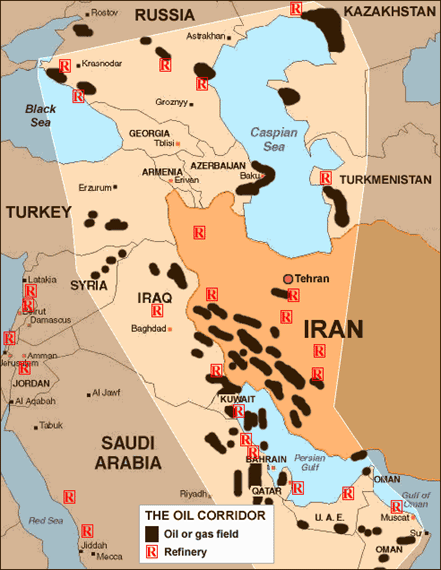
The so-called "Oil Corridor"

Long diplomatic negotiations were initiated but it wasn't until January 1930, that a compromise was achieved. The nationality clause was removed by the Colonial Office, and an oil company, under the umbrella of Standard Oil Company of California (SoCal), was established, termed BAPCO: Bahrain Petroleum Company. It was formed under the conditions that :
  1. that BAPCO would be a British company registered in Canada;
  2. that one of the five directors of BAPCO would be (at all times) a British subject, and his appointment would be made with consultation of the British government.
  3. that BAPCO would always have a Chief Local Representative resident in Bahrain whose channel of communication with the ruler of Bahrain would be through the Political Agent;
  4. that as many employees as possible of BAPCO in Bahrain would be British or Bahraini subjects.
Finally, the Open Door policy was officially sanctioned. Events moved quickly after that and on the 31st of May 1932, oil in commercial quantities was struck in Bahrain. In July 1933, an oil concession deal was struck with the Saudis that would later form the basis of the Arabian American Oil Company (ARAMCO)

John Bull's Face: 1932-1939

In 1938, an article entitled 'Is John Bull's Face Red!' appeared in The American Magazine , it was written in the form of an expose about an 'embarrassing British secret - how Americans beat them to a faraway island of oil [Bahrain]'. A mere article in an ongoing rivalry.

Within a month of the signing of the SoCal deal, the Political Agent in Bahrain expressed his concern that the US government would want to establish a consular office in Bahrain. He was firm in his belief that
It would be most undesirable to have a Consul of the United States of America in Bahrain, as with the Oil interests at his back, he [the would-be American ambassador] would be likely to acquire a powerful position - indeed, he might well tend to supplant the Political Agent!
The BAPCO oil refinery.
The position of the Political Agent in Bahrain was government by the second clause of the 1892 Exclusive Agreement whereby Bahrain undertook not to assent to the residence there of any country or entity but the representative of the British government

As such, he was the only foreign representative and, after the 1919 Order-in-Council, he was empowered to exercise jurisdiction over all foreigners.

Although no population census of Bahrain was taken during the 1930s, it can be assumed that roughly 18% of the population comprised of foreigners. These were Indians, Iranians , Omanis and other Arabs.

There was no Western Community, aside from that serving the British. When BAPCO started operations, the American community started to grow.

In January 1935, there were 24 Americans workers in Bahrain. By 1938, it reached 153 American workers.

World War II and Renewed Tensions:

Once WWII began, the position of the USA began to change, regarding its Gulf policies. Three principal factors governed this change:

The first was the gradual weakening of  Britain's position in the Arab world as a result of the defeats it suffered at the beginning of the war. In 1940, for example, the Mediterranean Sea became closed to British ships; the next year, Germany controlled Yugoslavia and Greece, Rommel's Afrika Korps pushed the British back to El Alamein. In Iraq, the Rashid Ali movement threatened British control over Iraq and its strategic base at Habbaniyya. The possible consequences of the collapse of the British in the Mid-East would have been disastrous to the Americans.

The second factor was an acute financial crisis in Saudi Arabic that set in immediately after the war, due to a massive decrease in Pilgrim traffic and financial mismanagement. It was so severe that in 1940, the King appealed to the British government for money. The US saw itself as not being ready for Saudi Politics but realizing the importance of Saudi oil, sent money to Britain that was to be given to Saudi Arabia.
World War II Scenario. El Alamein is clearly noted.

The third factor was the enter of the US into the war after Pearl Harbour. The Gulf became of great strategic importance for Allied supply lines and air routes. The importance of oil was acknowledged,, particularly in 1943, when the military and naval campaigns in the Far East were growing. By this time, the major US Departments [of War, of Navy, of the Interior, of the State] were actively involved in oil diplomacy.

The old scenario had changed. Roosevelt declared Saudi Arabia to be vital to the defence of America and hence made it eligible for the lend-lease act. For the first time, Britain was perceived as the strong rival for the implementation of the new policy.

Anglo-American rivalry in the Gulf now began in earnest and in two fronts: On the diplomatic level and in the field. It should be noted,however, that both countries were very close allies and relations did not falter. But the British wanted to strengthen their hold on the region, and the Americans wanted to undermine that hold.

Once the tension between the two was recognized, efforts to rationalize the relationship were made. A landmark in the process was the 1944 Anglo-American conversations on the Middle East, held in London. British policy on the Gulf region faced criticism from the Government of India. The reaction from the Viceroy was anger, he was furious at the acknowledgement of American ambitions in the region. He was particularly worried about an American request to build a US consulate in Bahrain, which he saw as unacceptable. Regardless of the criticism, the talks carried on.

In February 1944, an exchange of telegrams between Churchill and Roosevelt illustrated the fears of both sides. Churchill appealed to the US president that there were misgivings in Britain
That the United States has a desire to deprive us of our oil assets in the Middle East on which among other things, the whole supply of the Royal Navy depends on'
Roosevelt explained his side of the problem:
I am disturbed about the rumour that the British wish to horn in on our Saudi Arabian oil reserves.
A compromise was later reached with Churchill stating that :
We are not making Sheep's eyes at your oilfields in Iraq or Iran
The talks opened on the 12th of April 1944, and lasted for two weeks. The discussion covered many countries considered Middle Eastern including: Egypt, Ethiopia, Palestine, Syria, Lebanon, Iraq, Saudi Arabia, Yemen, Oman, Iran and Afghanistan.
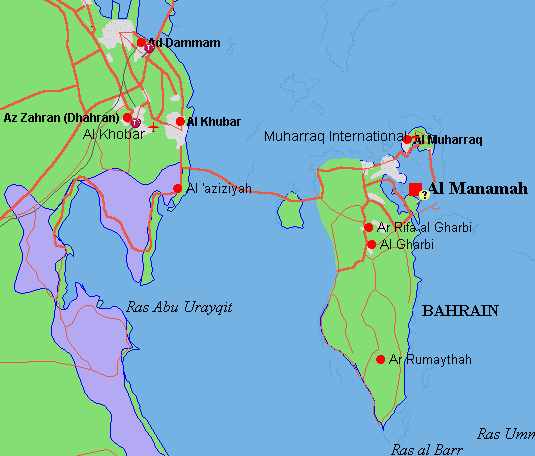
A map of Bahrain and nearby Saudi Arabia

The discussions concerning Bahrain revolved around the wish to establish an American consulate there. Britain refused such an action, citing previous treaty agreements as well as having the fear that this would spark a domino effect on the region. Finally, after much heated negotiations, Britain gave in and a consulate was established in early 1944 and (as predicted) , an American Consulate at Dhahran was opened in September 1944.

[It should be noted that during those times, establishing a consulate was not a simple case, as today, of adding one representative office to another and so on. It was not a routine establishment and it was very complex. It was a sign of influence and strength of a country to establish a  consulate. If one were to be established in Bahrain, it would undermine the British in Bahrain.]

Suspicions of the Americans by the British did not subside. The deployment of 270 soldiers of the US Army Transport Corps to the Consulate, added distrust. America also tried to monopolize the airline system during those times, intending to allow regular flights to and from Bahrain via American civil airlines, this however did not happen.

However, as soon as the war ended, American foreign policy in the region changed once again, this time towards the threat of Communism and of the Soviet Union. Particularly being focused on Russian activity in Iran, particularly after the Tudeh party made statements regarding Bahrain's status. The US now became less interested in Britain's position because of the risk that the Gulf would be an open door to the Russians.

The end of the war also brought with it the realization that Arab oil resources were so large that they could accommodate the interests of both USA and Britain. American policy in the Gulf now had six main thrusts:
  1. To encourage the US missionaries in every way;
  2. To support American commercial interests;
  3. To cooperate with British officials in order to promote US business interests;
  4. to refer to London any outstanding differences between Britain and the USA;
  5. To establish consulates in Muscat and beyond;
  6. To refrain from any measures that would open the region to Russian penetration.
The 3rd and 4th point above indicate the strength of Britain's position. Its main interest in the Gulf had always been strategic, not commercial. The fact that it had been able to withstand Americans resources had been vital to the conduct of the war attests to its ability to maintain the status quo. The political order it had created in the Gulf for over a century remained unchanged despite the dynamics of the changing economic situation. Once again, the Pax Britannica prevailed.

Based on research work done by R.S.Zahlan

Friday, 21 October 2011

Bahrain in the Second World War

Immediately after the United Kingdom had declared war on Nazi Germany, the ruler of Bahrain (Shaikh Hamad) sent the following telegram to the King of Britain.
"...For nearly a century, the Khalifa shaikhs of Bahrain have been on terms of friendship with the British Government...
...Our sympathies in this war which is now being waged against the evil forces of Nazism are with Great Britain. If we possessed an army, we would offer it to the British Government "
In other words, Bahrain was at war.

He also sent a check of £ 30,000 to help the British war effort. Two months later, the Shaikh of Bahrain said that all Muslims should support the Allies, this came at a time when Mussolini styled himself as "the new Caliph Omar". 

The local community started a fund for war charities and in November 1940, a fund was established to buy fighter aircraft for the RAF. By 1943, enough money was raised to buy ten fighter planes,

Bahrain's Defence:

Even though the fighting was restricted to Poland and mainland Europe, Shaikh Khalifa (who was in charge of public security) and Charles Belgrave (British advisor to Bahrain) began discussing defence plans for Bahrain. On the 1st of September 1939, Camel and horse riders were assigned to protect the strategic oil pipelines and refinery. After the demoralizing events of Dunkirk, a special defence force of 150 soldiers was raised to help the war effort. 

After Italy entered the war, rumours of Italian submarines being spotted in the Red sea and beyond became widespread.In September 1940, the crew of an sunken Italian submarine was captured and spent a few days in Bahrain before being deported to a prison camp in the British Raj. 

The following month, Bahrain had its most direct experience of the war. On the night of the 19th of October, 1940 (in an astonishing feat of airmanship), Italian aircraft from the Dodecanese bombed Bahrain via attacking the oil refinery in Awali and also in Dhahran. A total of 84 bombs were dropped but remarkably, no one was injured and no damage was done.

However, this event caused a mass panic amongst the civilian population, now realizing that the war is going to hit home. The British managed to use this attack as an excuse to rally Muslims behind them, stating that the Italian aircraft violated Meccan airspace during its journey.

Interesting fact : Shaikh Mohammed (the ruler's brother), had embarked on a trip to the Mediterranean before hostilities occurred. His Italian ship was due to dock in Beirut but as war was declared, the ship went straight to Italy, bearing Shaikh Mohammed with it. Somehow, he had managed to find his way to Malta, an island that was bombed six times daily. It was not until July 1940 did Shaikh Mohammed finally return home.


The region destabilizes:

In April 1941, Rashid Ali al Gaylani, an anti-British politician, became the Prime Minister of Iraq. Britain couldn't afford to have an Axis sympathizer in the oil heartland of the region and proceeded to invading Iraq and installing a puppet in his place.

When Reza Shah was overthrown in 1941, this caused a backlash against Persians in Bahrain. British troops and officers arrived and plans were discussed to improve the air defences. The overall reaction to Reza Shah's collapse was positive with approveness from a wide variety of people ranging from the upper class to smugglers (who rejoiced the overthrow because Reza Shah had an iron fist on smuggling operations).
The Middle East, in 1930.

The entry of Japan into the war in December 1941 and the subsequent collapse of the British position in South East Asia caused great excitement in Bahrain, particularly as many of its people had colleagues and business associates in Singapore (highlighting the extent of Bahraini trade).

At the same time, the German General Staff worked on one of the most ambitious strategic plans of the entire war. They aimed to launch a great spring offensive to force the Soviet Union to surrender and then to move through Turkey into the Gulf and hence interlink with the Japanese who would've achieved naval superiority in the Indian ocean by then.  

Whether or not the British knew of this plan is not known but they certainly took precautions. On the 16th of April 1942, the British Government announced that :
Bahrain has now come within the zone of operations 
A new RAF station was built in Muharraq, an Air Raid Precautions committee was established, a dug-out was built at the Girls' School, incendiary bomb demonstrations were held and police practiced taking cover during air attacks. In the summer of 1942, reports emerged of unidentified naval destroyers were spotted off the coast of Kuwait and Qatar (likely to have been either the Japanese or confusion).
The RAF insignia for the Muharraq base


A conscription-like campaign was launched and had raised a force of 250 levies based in Muharraq. Many more men were recruited that Belgrave stated that

Muharraq had begun to look like a garrison town
By the spring of 1943, the tide of war had turned. The Germans, after the defeats at Stalingrad and El Alamein , no longer posed a threat to the Middle East.


The Japanese had lost their momentum after being checked by the US Navy. By this time, British soldiers were relocated to other fronts and the levies were disbanded.


Wartime Economy, Rations:

Bahrain was not immune from the rations of WWII. Bahrain had managed to keep the supply of food running since 1939 (25,000 bags of rice were bought from Calcutta alone!) and the shortages started to occur in 1941. An agricultural committee was established to help make more crops but results were not expected. In addition, that winter there was a shortage of vegetables and rice which had previously come in tins from India ; The Indian Government banned the export of anything using tins in order to save metal.
A souq in present-day Bahrain

Rations were officially launched in March 1942, under the vanguard of the Manama Baladiyah (Municipality). Eight centres were opened up to distribute sugar at controlled prices ; each adult received a ticket that entitled him to 4 pounds of sugar a month.

By May, the food situation became satisfactory although there was a severe shortage of bread. This was due to limited imports from India.

To compensate the inevitable increase in food prices, the Bahraini government introduced a War allowance for all those earning less than Rs 150 a month (the average wage was a rupee a day).

With a ration card, an adult was entitled to 12 pounds of rice, 4 pounds of wheat and flour as well as 4 pounds of sugar in a single month.

As a result of Iraq's anti-British sentiments and the Anglo-Iraqi war, imports from Iraq were banned. This was counter-productive as it lead to a shortage of dates. However, a deal between Saudi Arabia and Bahrain allowed 15,000 bags of dates to help solve the shortage problem.Food became scarce and the ration of sugar was cut to 2 pounds, rice to 8 pounds. Once the Anglo-Iraqi war concluded, Bahrain imported a massive 2,000 tonnes of dates within the first month!

In the villages, dates were distributed for free at each of the town squares, and a food centre was established at Souq al Khamis. Even so, signs of malnourishment was reported amongst the elderly and young.
Hyperinflation caused prices to fluctuate, causing prices of Dates (originally 4 rupees) to skyrocket to 30 rupees, the price of tea rose enormously as well, and many butchers (having a lack of imports) closed down.

Other Developments:

We must not have the impression that life in Bahrain revolved around the war, during this time. The death of Shaikh Hamad in February 1942 caused region-wide grief. Government income rose during this period from 3,717,000 rupees (in 1939) to 5,634,000 rupees (in 1946). A smallpox outbreak broke out in 1941, which resulted in a mass-vaccination campaign to be launched. 
Shaikh Salman Bin Hamad Al-Khalifa (left) and Sir Charles Belgrave 

In 1940, there were 3 girls' schools with 450 students, by 1945, there were 5 girls' schools with 1,139 students. 

The Manama College was opened to give 13-14 year old boys three years' further education in English. Hostel accommodation was introduced for the first time.

In November 1940, Bahrain Radio Station went on the air, and in January 1941 , the first census was held showing a population of just under 90,000. In December 1941, the bridge between mainland Bahrain and Muharraq was opened. In May 1945 Bahrain played their first football match with Saudi Arabia.

After the war, the British Government thanked the Shaikh and his people for their service in the war. Free meals were distributed in Manama, Muharraq and Hidd throughout the month of May, 1945 in celebration. 

Based on the research of Robin Bidwell.

Friday, 7 October 2011

The History of Ice cream

Perhaps one of the most iconic cold snacks of all times, popularized in the 20th century due to the availability of refrigerators. The ice cream has been a sign of a simple way to have a cheap but ever-so-sweet snack during the blistering heat. But the history of ice cream goes back millenniums! In this post, we shall examine and find out who invented (or rather, discovered) the ice cream, when did it go mainstream and stuff.

When Did It First Appear:

Records show that the Persian Empire is credited to have invented the ice cream. According to historians, sometime prior to 400 BC, people would pour concentrated grape juice over snow and eat it whenever the weather used to be hot (apparently, underground chambers were used to storage rooms for this treat).Cities such as Hamedan had seen this occur.

During later periods, modifications and additions were made to the ice cream, such as adding rose water and herbs. By around 200 BC, ice cream appeared in ancient China which was in the form of frozen milk and rice! The Romans soon followed, using snow covered with fruit toppings.

Perhaps the first real mainstream version of ice cream was created by the Arabs in the 10th century, who (for the first time ever) used milk as a main ingredient (heavily sweetened with sugar) instead of the traditional fruit juices.
By this time, it had been widespread throughout the Arab World.

During the 1500s and 1600s, Ice-cream finally appeared in Europe, it was so tasty that legends say that :
Charles I of England was supposedly so impressed by the "frozen snow", that he offered his own ice cream maker a lifetime pension in return for keeping the formula secret, so that ice cream could be a royal prerogative.
Though, it is fair to say that it was largely restricted to aristocrats and the upper class.

Real Ice cream:

Real Ice cream, otherwise known as the ice cream we consume today, was thought to have been invented in 18th England and America. It even appeared in a cookbook [Mrs. Mary Eales's Receipts]:

To ice cream.
Take Tin Ice-Pots, fill them with any Sort of Cream you like, either plain or sweeten’d, or Fruit in it; shut your Pots very close; to six Pots you must allow eighteen or twenty Pound of Ice, breaking the Ice very small; there will be some great Pieces, which lay at the Bottom and Top: You must have a Pail, and lay some Straw at the Bottom; then lay in your Ice, and put in amongst it a Pound of Bay-Salt; set in your Pots of Cream, and 93 lay Ice and Salt between every Pot, that they may not touch; but the Ice must lie round them on every Side; lay a good deal of Ice on the Top, cover the Pail with Straw, set it in a Cellar where no Sun or Light comes, it will be froze in four Hours, but it may stand longer; then take it out just as you use it; hold it in your Hand and it will slip out. When you wou’d freeze any Sort of Fruit, either Cherries, Rasberries, Currants, or Strawberries, fill your Tin-Pots with the Fruit, but as hollow as you can; put to them Lemmonade, made with Spring-Water and Lemmon-Juice sweeten’d; put enough in the Pots to make the Fruit hang together, and put them in Ice as you do Cream.
In 1744, the word Ice-cream appeared in the Oxford English Dictionary.
Ice cream was brought to America via Quaker colonists, and it was thought to have been a favourite treat to the likes of Ben Franklin, George Washington and Thomas Jefferson.

Also, in 1843, Nancy Johnson of Philadelphia was issued the first U.S. patent for a small-scale handcranked ice cream freezer. The Ice-cream cones, sunday and Banana splits became famous around the turn of the century.
Vanilla flavoured ice cream! You know you want it
Though in the UK, it was still expensive to buy ice-cream and hence, Britain relied on imports of snow from Norway and America.

It was only during the second half of the 20th Century did ice-creams become cheap, due to the widespread availability of refrigerators. During this time, companies such as Baskin Robbins were established with mottos like "31 flavors for each day of the month".

An important feature during this time was the invention of 'Soft Ice-Cream'.It was invented in Britain by a chemistry team (of which, future British Prime Minister Margaret Thatcher was a part of). Companies such as Dairy Queen pioneered the age of soft ice-cream.

But today, Ice-cream is widely available and is relatively nothing in price, when compared to previous years. Ice-cream is now available in more than a thousand different flavours , modified with every country and culture it meets and it continues to be one of the most iconic symbols of the human diet.

The Deforestation of Nabih Saleh in Bahrain - in Maps!

 This post is an example of the invaluable information and data provided by the groundbreaking people at mapBH . For those unaware, mapBH is...